
Vitzrocell earnings are gaining momentum in 2026 as the South Korean battery manufacturer reported double-digit growth in revenue and operating profit and a 62.1% jump in first-half net income.
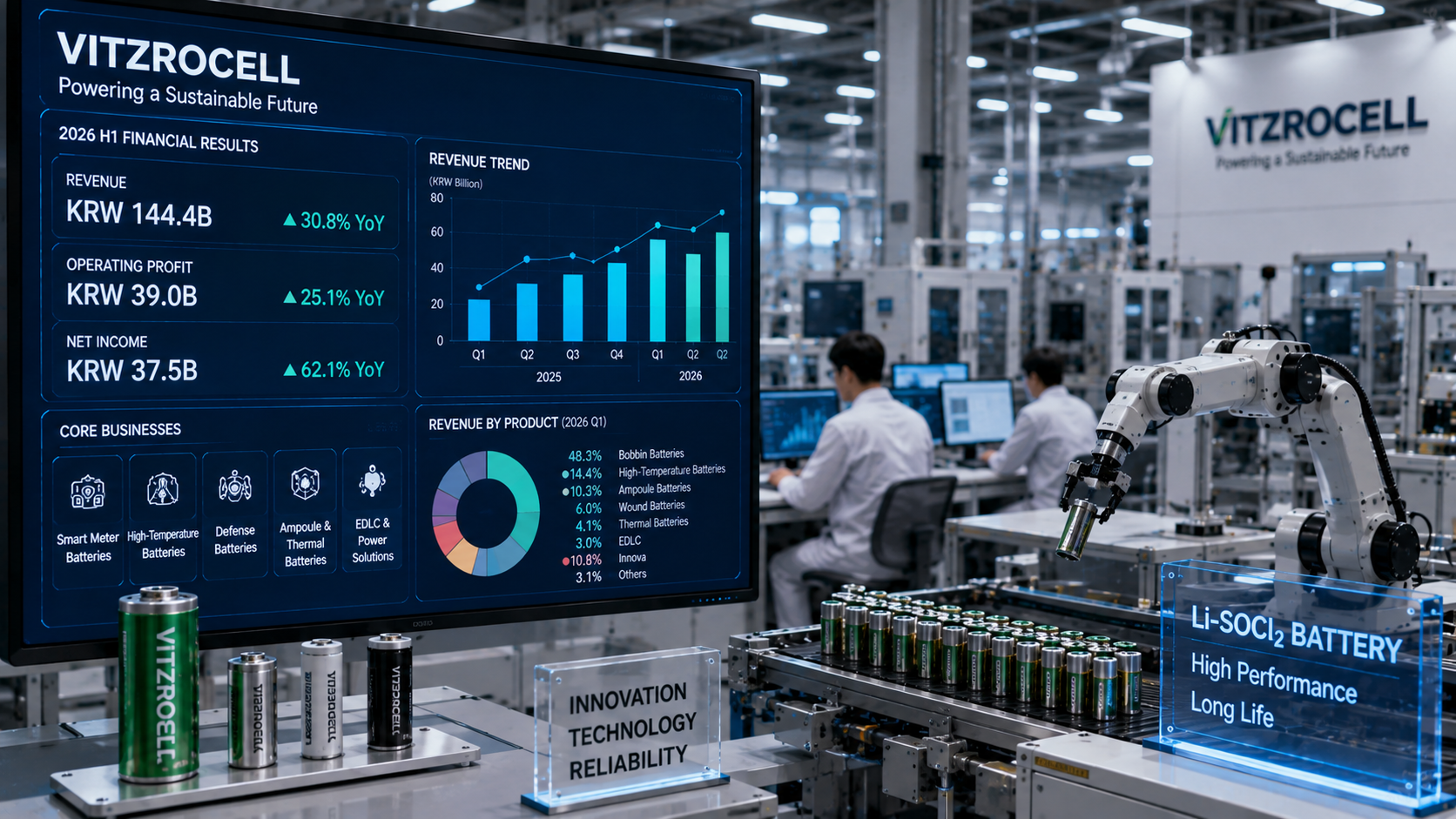
Vitzrocell reported consolidated revenue of KRW 144.4 billion for the first half of 2026, up 30.8% from KRW 110.5 billion a year earlier. Operating profit increased 25.1% to KRW 39.0 billion, while net income climbed 62.1% to KRW 37.5 billion.
The results put the company in a strong position heading into the second half of the year. Vitzrocell expects revenue, operating profit and net income to potentially reach record annual levels in 2026, a target the company describes as a financial “Triple Crown.”
That outcome has not yet been achieved and remains management’s forecast. However, current order conditions, continued smart-meter battery demand, growth in high-temperature and defense batteries, and contributions from acquired Canadian company Innova Power Solutions provide several potential growth drivers.
The first-half performance also illustrates how Vitzrocell is expanding beyond its traditional lithium primary battery operations into a more diversified portfolio of specialized energy products.
Vitzrocell Earnings Rise Sharply in H1
The strongest headline from the latest financial results is the scale of Vitzrocell’s first-half growth.
Revenue reached KRW 144.4 billion, compared with KRW 110.5 billion during the same period last year. That represents growth of 30.8%.
Operating profit increased from approximately KRW 31.2 billion to KRW 39.0 billion, a 25.1% increase.
Net income recorded the fastest growth, rising 62.1% to KRW 37.5 billion.
EBITDA also rose substantially, increasing 64.6% year over year to KRW 48.9 billion.
The combination is significant because the company is not simply generating higher sales. Earnings are also increasing substantially as its product mix expands.
Vitzrocell believes the current momentum creates an opportunity to set new annual records across its major financial metrics.
Investors will nevertheless need to wait for second-half results before determining whether those targets are achieved.
Second-Quarter Revenue Reaches KRW 76.2 Billion
Second-quarter results provide additional evidence that the growth continued through the middle of the year.
Vitzrocell recorded quarterly revenue of KRW 76.2 billion, up 34.8% from the same quarter in 2025.
Operating profit increased 16.3% to KRW 18.8 billion, while net income surged 70.3% to KRW 17.3 billion.
Operating profit therefore grew more slowly than revenue during the quarter.
The company attributed the difference partly to approximately KRW 2.9 billion in one-time executive retirement-related expenses and the impact of consolidating Innova’s financial results.
Second-quarter operating margin was 24.6%, down from 28.5% in the comparable period.
For the entire first half, operating margin came to approximately 27.0%, compared with 28.3% a year earlier.
Net profit margin moved in the opposite direction, rising from about 21.0% to 26.0%.
Vitzrocell expects profitability to strengthen again beginning in the third quarter as temporary factors ease.
Smart Meter Batteries Remain the Foundation
The core of Vitzrocell’s business remains lithium primary batteries.
These batteries differ from the rechargeable lithium-ion cells commonly associated with electric vehicles and smartphones.
Primary batteries are designed for applications where long operating life, low self-discharge and reliability can be more important than rechargeability.
Smart metering is one of Vitzrocell’s most important markets.
Electricity, gas and water meters increasingly use wireless communication systems to automatically transmit consumption information. These devices may remain installed for many years, making battery reliability particularly important.
Vitzrocell says its lithium primary batteries are exported to more than 50 countries and are widely used in the smart-meter market.
This gives the company exposure to a long-term infrastructure trend rather than relying entirely on short consumer-electronics cycles.
Utilities worldwide continue replacing traditional meters with connected devices as power grids and infrastructure become increasingly digital.
Vitzrocell expects stable growth in this business to continue during the second half of 2026.
Bobbin Batteries Lead the Product Mix
Regulatory filings provide a clearer picture of how important this market is.
During the first quarter of 2026, Vitzrocell generated KRW 32.98 billion from bobbin batteries.
That represented 48.3% of consolidated quarterly revenue, making bobbin batteries the company’s largest individual product category.
Bobbin-type lithium thionyl chloride batteries are particularly suited to applications requiring long operating life and low continuous power consumption.
Smart meters are a natural application because they need to operate reliably for long periods while periodically transmitting data.
Vitzrocell’s official specifications emphasize characteristics including stable operating voltage and low self-discharge.
The company lists annual self-discharge of less than 1% under specified room-temperature storage conditions for one of its lithium primary battery products.
These characteristics help explain why lithium primary batteries remain relevant even as rechargeable battery technology attracts much of the industry’s attention.
Different applications require different battery characteristics.
High-Temperature Batteries Drive Expansion
High-temperature batteries represent another important part of Vitzrocell earnings and future growth.
These batteries are designed for industrial environments where conventional battery technology may struggle.
Oil and gas drilling is one of the primary applications.
Electronic tools used deep underground can encounter high temperatures, vibration and pressure while collecting data or controlling drilling operations.
Reliable power is essential under those conditions.
Vitzrocell’s first-quarter regulatory filing shows that high-temperature batteries generated KRW 9.86 billion in sales during the first three months of 2026.
That represented 14.4% of consolidated revenue.
Vitzrocell expects high-temperature battery sales to continue growing during the second half.
This market is particularly important because specialized industrial batteries can provide greater value than more standardized battery products.
Customers are purchasing performance under extreme operating conditions rather than simply energy capacity.
Innova Adds a North American Growth Platform
The high-temperature business is also closely connected with Innova Power Solutions.
Innova specializes in battery packs and monitoring-chip solutions for downhole tools used in oil and gas operations.
The Canadian company is now a consolidated Vitzrocell subsidiary.
Vitzrocell’s regulatory filing shows that Innova contributed KRW 7.35 billion of additional consolidated revenue during the first quarter of 2026.
That represented 10.8% of total quarterly revenue.
The contribution demonstrates why Innova has become an important part of Vitzrocell’s growth story.
The acquisition gives the company additional capabilities beyond individual battery cells.
Battery-pack design and monitoring technology can allow Vitzrocell to provide more integrated power solutions to industrial customers.
It also strengthens the company’s position in North America, an important market for oil and gas applications.
Management expects additional business synergies from Innova during the second half.
Acquisition Growth Requires Context
Innova’s contribution also means investors should interpret Vitzrocell’s growth rates carefully.
When an acquired company begins contributing to consolidated financial statements, reported revenue can rise because the corporate group itself has become larger.
That differs from organic growth generated entirely by the existing business.
Vitzrocell’s first-half results therefore reflect a combination of underlying business expansion and the inclusion of Innova.
The company says profitability and growth in its existing operations remain solid despite the temporary impact associated with Innova’s consolidation.
Over the coming quarters, comparisons should become easier as Innova becomes part of both current and prior-period results.
More important than the initial accounting impact will be whether the acquisition generates sustainable operational synergies.
Those could include cross-selling, improved North American market access, technology integration and expansion of Vitzrocell’s high-temperature battery portfolio.
Defense Batteries Become More Important
Defense is another high-value market within Vitzrocell’s portfolio.
The company produces ampoule and thermal batteries for military applications.
Its official product catalog lists applications including electronic fuze systems, naval and artillery guns, multiple launch rocket systems and remote anti-armor mine systems.
Military batteries have unusual requirements.
Some systems may remain unused for many years before they are activated.
Once activated, they must provide reliable power rapidly and under demanding environmental conditions.
Vitzrocell’s ampoule battery specifications include shelf lives exceeding 15 years for certain products as well as wide operating-temperature ranges.
These characteristics create a specialized market with technical barriers that differ from those found in consumer batteries.
Vitzrocell expects higher sales of defense-related ampoule and thermal batteries to support second-half growth.
Defense Already Represents Meaningful Revenue
Defense batteries are not merely a future opportunity.
They already contribute materially to the company’s product mix.
Vitzrocell reported KRW 7.01 billion in first-quarter ampoule battery sales, representing 10.3% of consolidated revenue.
Thermal batteries generated another KRW 2.79 billion, or 4.1% of quarterly revenue.
Together, these categories accounted for more than 14% of first-quarter sales.
Vitzrocell’s official product portfolio confirms that the company offers both ampoule and thermal military batteries alongside military battery packs.
The segment provides diversification because military procurement follows different demand drivers from smart-meter infrastructure or oil drilling.
However, defense sales can also be uneven because large procurement contracts may be influenced by government budgets and delivery schedules.
That makes quarterly performance less predictable than recurring demand from some industrial markets.
Product Diversification Supports Growth
Vitzrocell’s first-quarter revenue breakdown shows a business that is becoming increasingly diversified.
Bobbin batteries accounted for 48.3% of revenue.
High-temperature batteries represented 14.4%.
Ampoule batteries contributed 10.3%.
Wound batteries represented 6.0%, thermal batteries 4.1% and EDLC products 3.0%.
Innova added 10.8%.
Smaller contributions came from lithium manganese dioxide batteries, lithium-ion batteries and other products and services.
The product mix is significant because the end markets do not necessarily move together.
Smart-meter demand is connected to utility infrastructure.
High-temperature batteries depend partly on industrial and energy activity.
Military batteries depend on defense procurement.
Diversification can therefore help reduce reliance on one market.
At the same time, specialized products require different manufacturing processes, customer relationships and technical expertise.
Managing that complexity while maintaining profitability will be important as Vitzrocell expands.
Profitability Is Central to the 2026 Outlook
Vitzrocell is emphasizing that its 2026 objective involves more than record sales.
Management expects revenue, operating profit and net income to all reach record levels.
The company also expects operating and net profit margins to improve over the full year, describing the objective as “qualitative growth.”
This distinction matters.
A manufacturer can increase revenue without necessarily creating greater economic value if costs increase equally quickly.
Improving margins indicate that a larger proportion of revenue is becoming profit.
The first half presents a mixed but generally positive picture.
Operating margin declined modestly year over year because of second-quarter factors, while net profit margin improved significantly.
Management believes operating profitability can recover from the third quarter.
If that occurs while revenue continues expanding, Vitzrocell would have a stronger path toward its record full-year targets.
Specialized Batteries Offer Different Economics
Vitzrocell occupies a different position from the large South Korean battery manufacturers primarily associated with electric vehicles.
Its core products serve specialized industrial applications.
Smart meters may require batteries capable of functioning for many years.
Downhole drilling tools need batteries that tolerate extreme temperatures.
Military systems may require long shelf life followed by rapid and reliable activation.
Those requirements can create barriers to entry.
Customers may prioritize reliability, qualification history and specialized engineering rather than choosing a supplier purely on price.
This can support attractive economics for manufacturers with proven technology.
Vitzrocell’s first-half operating margin of approximately 27% illustrates the profitability that can be achieved in these specialized markets, although future margins can vary with product mix and costs.
The company’s challenge is to preserve those economics as it expands internationally and enters new product categories.
New Battery Markets Could Add Future Growth
Vitzrocell is also investing beyond the businesses responsible for most of its current earnings.
The company has identified film-type batteries, special-purpose rechargeable batteries and materials, and lithium recycling among areas intended to create future growth opportunities.
Its current product portfolio already extends beyond conventional primary batteries to include lithium-ion batteries, secondary battery materials, EDLCs and lithium-ion capacitors.
This strategy could gradually broaden the company’s addressable market.
However, new technology initiatives should be distinguished from established revenue sources.
Vitzrocell’s current earnings remain driven primarily by its existing lithium primary battery, high-temperature, defense and Innova businesses.
New battery technologies may eventually become meaningful contributors, but commercial scale will need to be demonstrated through future financial results.
Smart Infrastructure Supports Long-Term Demand
One reason the smart-meter business remains strategically attractive is the continued digitalization of infrastructure.
Traditional utility meters require manual or periodic reading.
Smart meters can communicate consumption data automatically, giving utilities more detailed information about electricity, gas or water usage.
These systems can also support more sophisticated grid management.
As electricity systems integrate renewable energy, distributed generation, electric vehicles and energy storage, utilities increasingly need better visibility into consumption and network conditions.
Battery-powered meters form a small but important component of that infrastructure.
The market therefore connects Vitzrocell to the broader transition toward digital energy systems without requiring the company to compete directly in large-scale EV battery production.
Its long-life primary battery technology is particularly suited to devices expected to remain deployed for extended periods.
Industrial Reliability Is the Common Theme
Although Vitzrocell serves several different markets, a common characteristic connects many of them: reliability.
A smart meter may be difficult or expensive to service frequently.
A drilling tool can operate deep underground.
A defense system may remain stored for years before use.
These applications place a premium on predictable battery performance.
That is a different competitive environment from consumer electronics, where charging speed, physical size and rapid product cycles can dominate purchasing decisions.
For Vitzrocell, specialized industrial requirements provide an opportunity to compete through engineering expertise.
Its official product information highlights attributes such as low self-discharge, stable voltage, long shelf life and operation across wide temperature ranges.
These technical characteristics are closely aligned with the markets generating much of the company’s current revenue.
Risks Remain Despite Strong Vitzrocell Earnings
Strong first-half performance does not guarantee that the same growth rate will continue.
Vitzrocell remains exposed to several risks.
Demand for high-temperature batteries can be influenced by oil and gas investment.
Defense revenue depends partly on procurement cycles.
Smart-meter projects can be affected by infrastructure spending.
International operations introduce currency and geopolitical risks.
The Innova acquisition also creates integration challenges.
Vitzrocell needs to combine operations effectively while preserving customer relationships and realizing the commercial benefits expected from the transaction.
The company’s second-quarter operating margin demonstrates that acquisitions and one-time expenses can temporarily affect profitability even during periods of strong revenue growth.
New businesses create additional execution risk because investments do not automatically translate into commercial success.
These factors make subsequent earnings reports important for evaluating whether current momentum is sustainable.
Second Half Will Determine the Record
The company’s central objective is straightforward: make 2026 its strongest financial year to date.
First-half results have created a solid foundation.
Revenue rose 30.8% to KRW 144.4 billion.
Operating profit increased 25.1% to KRW 39.0 billion.
Net income jumped 62.1% to KRW 37.5 billion.
Management expects smart-meter batteries to continue providing stable growth while high-temperature and defense products expand.
Innova is expected to contribute additional sales and synergies.
Profitability is also expected to improve after temporary second-quarter factors.
If those assumptions hold, Vitzrocell could finish the year with record results across all three financial measures.
But the “Triple Crown” remains an outlook rather than an accomplished result.
Actual second-half performance will determine whether the company reaches that milestone.
Vitzrocell Enters H2 With Momentum
The broader significance of Vitzrocell earnings lies in how the company’s business is evolving.
Lithium primary batteries remain the foundation, particularly in smart-meter applications.
But high-temperature batteries, military power systems and Innova are creating additional sources of growth.
The company is also investing in technologies that could broaden its business further over the longer term.
This gives Vitzrocell a somewhat unusual position in the battery industry.
Rather than competing primarily for the enormous EV battery market, it focuses on specialized applications where long life, reliability and extreme operating conditions can matter more than mass-market scale.
The first half of 2026 suggests that strategy is currently producing substantial financial growth.
Whether it can deliver record full-year results will become clearer over the next two quarters.
For now, revenue growth above 30%, operating profit growth above 25% and net income growth above 60% give Vitzrocell a strong starting point as it pursues its most ambitious annual earnings target yet.