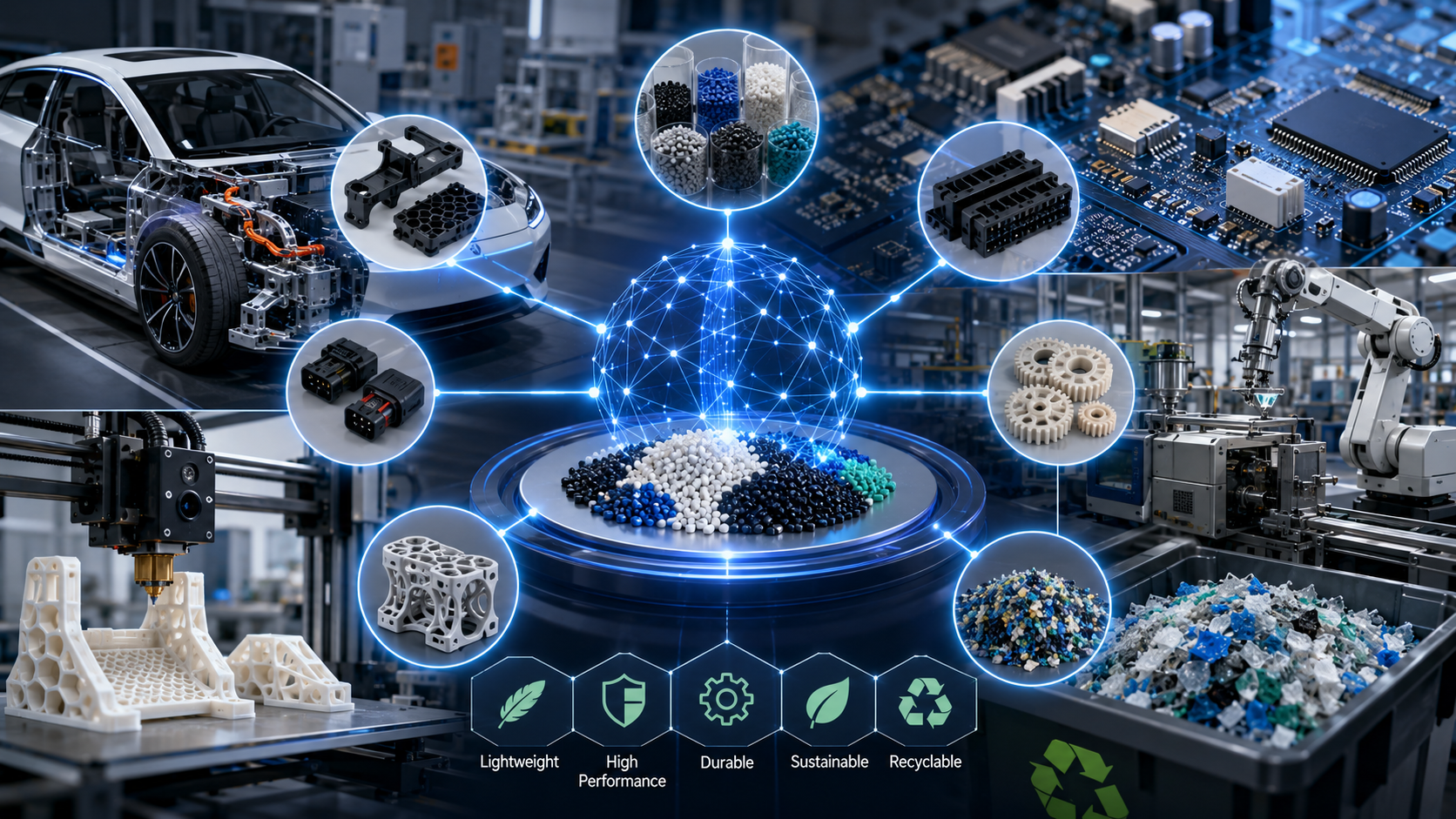

The engineering plastics market is entering a new phase of growth as electrification, advanced electronics, sustainability requirements and changing manufacturing strategies increase demand for lightweight materials capable of replacing metals and conventional plastics in demanding applications.
Frost & Sullivan projects the global engineering plastics industry will expand from approximately $56.95 billion in 2025 to $78.61 billion by 2032, representing a compound annual growth rate of about 4.7%.
The growth is being driven by more than rising plastics consumption.
Manufacturers are changing what they expect from materials.
Electric vehicles require lighter components while introducing new thermal, electrical and safety requirements. Electronics manufacturers need polymers capable of supporting increasingly compact and powerful devices. Industrial companies want materials that can withstand demanding operating conditions while reducing production complexity.
At the same time, companies are under pressure to increase recycled content, reduce environmental impact and rethink what happens to materials at the end of a product’s life.
These forces are turning engineering plastics from conventional material inputs into strategic manufacturing technologies.
Engineering Plastics Market Targets $78.6 Billion
Frost & Sullivan’s latest analysis covers the global engineering plastics industry between 2025 and 2032.
The research includes major polymer families such as polycarbonate, polyamides, polyoxymethylene, thermoplastic polyesters including PBT and injection-grade PET, styrenics such as ABS, SAN and ASA, and polymethyl methacrylate.
These materials are used when ordinary commodity plastics cannot provide sufficient mechanical strength, thermal resistance, dimensional stability or other performance characteristics.
Their applications span automotive and aerospace, electrical and electronics, construction, packaging, consumer goods and industrial products.
The forecast therefore reflects several manufacturing sectors simultaneously.
Growth in electric vehicles can influence demand.
Expansion of electronics manufacturing can influence demand.
Industrial automation, healthcare products and advanced consumer devices can also affect the market.
This diversification helps explain why engineering plastics are becoming strategically important across the manufacturing economy.
Why Engineering Plastics Are Different
Not all plastics are designed for the same purpose.
Commodity plastics are optimized largely around affordability and mass production.
Engineering plastics are designed to provide stronger performance under demanding conditions.
Depending on the polymer and formulation, they can offer higher mechanical strength, impact resistance, chemical resistance, dimensional stability, electrical properties and heat resistance.
Those characteristics allow engineers to consider plastics for applications historically dominated by metals, glass or other materials.
The advantage is not simply replacing one material with another.
A plastic component can sometimes integrate several functions into a single molded part.
That can reduce component count.
It can simplify assembly.
It can lower weight.
And it can potentially reduce manufacturing costs.
This ability to redesign products is one reason engineering plastics have become important to automotive, electronics and industrial manufacturers.
Electric Vehicles Are Changing Material Demand
The transition from internal-combustion vehicles to electric vehicles is one of the most important changes affecting the materials industry.
EVs contain different mechanical and electrical architectures.
Large battery packs increase vehicle weight, creating pressure to reduce mass elsewhere.
Electrical systems operate at higher voltages.
Thermal management becomes critical.
Battery protection introduces new safety requirements.
Charging infrastructure creates additional demand for electrically and thermally capable materials.
Engineering plastics can address some of these requirements.
Lightweight polymer components can replace heavier materials in appropriate applications.
Specialized formulations can provide electrical insulation.
Flame-retardant materials can help meet safety requirements.
Heat-resistant polymers can operate around demanding electronics.
As EV platforms evolve, material suppliers therefore have opportunities to develop increasingly specialized formulations.
Lightweighting Is About More Than Efficiency
Vehicle lightweighting has traditionally been associated with fuel economy.
In electric vehicles, it can directly affect driving range.
A lighter vehicle requires less energy to move.
Reducing mass can therefore help manufacturers extract more useful range from a battery.
But lightweighting cannot compromise structural performance or safety.
Automakers need materials that reduce weight while still meeting mechanical, thermal and regulatory requirements.
Engineering plastics occupy an important position in this trade-off.
They cannot replace metals everywhere.
But in suitable applications, high-performance polymers can provide meaningful weight reductions while enabling more complex component geometries.
The result is a broader competition between plastics, metals, composites, ceramics and other advanced materials.
Electronics Are Another Major Growth Engine
Electronics provide another strong source of demand.
Modern electronic devices are becoming smaller, more powerful and more integrated.
This increases pressure on the materials surrounding electrical components.
Polymers may need to provide electrical insulation.
They may need to tolerate elevated temperatures.
They can require precise dimensional stability.
They may also need flame-retardant characteristics.
These requirements appear across consumer electronics, industrial equipment, telecommunications hardware and increasingly sophisticated vehicles.
The growth of AI infrastructure could indirectly reinforce this trend.
AI servers, networking systems, power electronics and cooling equipment require enormous ecosystems of electrical components.
While engineering plastics are only one small part of that infrastructure, continued expansion of high-performance electronics broadens the number of applications where advanced polymers can be considered.
Sustainability Is Reshaping the Market
Perhaps the largest structural change involves sustainability.
Historically, material selection often focused primarily on performance, availability and price.
Environmental considerations are becoming another major variable.
Manufacturers increasingly need to understand where raw materials originate.
They need to consider carbon footprints.
They face pressure to incorporate recycled materials.
They also need to think about what happens when products reach the end of their useful lives.
Frost & Sullivan identifies circular material ecosystems, chemical recycling and feedstock recovery as important developments affecting engineering plastics business models.
This creates both challenges and opportunities.
High-performance materials need to retain their required properties even as manufacturers increase recycled or alternative feedstocks.
Circular Engineering Plastics Could Create New Value Chains
The conventional plastics industry largely follows a linear model.
Raw materials are produced.
Products are manufactured.
Consumers use those products.
Waste is eventually discarded.
Circular models attempt to keep materials in economic use for longer.
Mechanical recycling is one approach.
Chemical recycling provides another potential route by breaking plastic waste into chemical building blocks that can be used again.
Bio-based feedstocks can provide another option for reducing dependence on fossil resources.
Frost & Sullivan identifies recycled feedstocks, chemical recycling and bio-based materials as areas receiving increased investment.
If these technologies scale successfully, the engineering plastics value chain could become much more complicated.
Waste collection companies, recyclers, chemical producers, polymer manufacturers and OEMs may need to work together more closely.
Material Suppliers Are Moving Closer to OEMs
Another important trend is closer collaboration between material suppliers and manufacturers.
Frost & Sullivan describes this as compression of the customer value chain.
OEMs are increasingly involving material suppliers earlier in product development rather than selecting materials only after a design has largely been completed.
This can accelerate innovation.
A material supplier that understands the final application can modify polymer formulations around specific performance requirements.
Engineers can simultaneously redesign components around the characteristics of the material.
That creates a feedback loop between material science and product engineering.
For automotive and electronics companies, this could shorten development cycles and produce components optimized from the beginning rather than modified later.
Mold-in-Color Could Eliminate Production Steps
One of the growth opportunities identified by Frost & Sullivan is mold-in-color technology.
Traditional manufacturing may involve molding a plastic component and then painting or coating it to achieve the required appearance.
Mold-in-color approaches integrate color directly into the material.
That can eliminate or reduce painting processes.
The benefit is not simply cosmetic.
Removing a manufacturing step can reduce production time.
It can reduce equipment requirements.
It may lower energy use.
It can also reduce materials associated with coatings.
For high-volume manufacturing, eliminating even one production stage can have meaningful economic effects.
Automotive interiors and consumer products are obvious potential applications.
3D Printing Opens Another Growth Channel
Additive manufacturing is another area where engineering plastics could expand.
Industrial 3D printing is moving beyond rapid prototyping toward actual production.
The technology is particularly useful when manufacturers need customized components, complex geometries or relatively small production volumes.
Traditional injection molding can be extremely economical at high volume.
But molds themselves are expensive.
If only a small number of parts are required, the economics can be unfavorable.
3D printing changes that calculation.
Components can be manufactured directly from digital designs without dedicated molds.
Frost & Sullivan identifies additive manufacturing as a growth opportunity for engineering plastics, particularly for customized and application-specific production.
The challenge is materials.
Industrial users need printable polymers capable of meeting demanding mechanical and thermal requirements.
That creates opportunities for higher-performance engineering formulations.
India Is Emerging as a Manufacturing Opportunity
Geography is also changing the market.
Frost & Sullivan highlights India’s localization trend as a significant growth opportunity.
India is expanding its domestic manufacturing ecosystem while supporting investment in automotive, electronics and advanced industrial production.
According to the analysis, this creates opportunities across polymer production, compounding and advanced processing technologies.
The broader implication is important.
Engineering plastics demand does not simply follow global GDP growth.
It follows where manufacturing capacity is being built.
When a country expands vehicle production, electronics manufacturing and industrial supply chains, demand for advanced materials can rise alongside it.
This makes regional manufacturing policy increasingly relevant to global chemical and materials companies.
Asia-Pacific Remains Strategically Important
Asia-Pacific already plays a major role in the engineering plastics market because the region contains enormous automotive, electronics and consumer manufacturing industries.
China, Japan, South Korea, India and Southeast Asian manufacturing hubs collectively create substantial material demand.
The region also contains major polymer producers, compounders and component manufacturers.
This creates an integrated ecosystem where materials can move relatively quickly from chemical production into finished goods.
As companies diversify manufacturing footprints, regional supply chains could become even more important.
Manufacturers increasingly evaluate not only material performance but also supply security.
A technically excellent polymer is less useful if geopolitical disruption or logistics problems prevent reliable delivery.
Supply Chains Remain a Major Risk
Engineering plastics remain closely connected to petrochemical feedstocks.
That exposes producers to fluctuations in energy prices and raw-material availability.
Frost & Sullivan identifies feedstock and cost volatility as important market risks.
This is especially challenging for manufacturers that negotiate long-term contracts with customers.
A sudden increase in feedstock costs can compress margins.
Passing the increase to customers can make the material less competitive.
Energy prices create another variable because polymer manufacturing can be energy intensive.
Supply-chain resilience therefore becomes part of material strategy.
Companies may seek multiple suppliers.
They may regionalize production.
They may investigate alternative feedstocks.
And they may invest in recycling partly to reduce dependence on virgin raw materials.
Engineering Plastics Compete With Metals
Engineering plastics do not operate in isolation.
They compete with metals, ceramics, glass, composites and other polymers.
The appropriate material depends on the application.
Metal may provide superior strength for one component.
Plastic may offer better weight and manufacturing economics for another.
Composites may be appropriate where extremely high strength-to-weight ratios are required.
Frost & Sullivan notes that material selection increasingly involves balancing performance, cost, sustainability and manufacturing convenience.
This means growth in engineering plastics will not necessarily come from simply replacing commodity plastics.
Some of the most valuable opportunities could involve applications currently served by completely different materials.
Material Substitution Requires Better Engineering
Replacing metal with plastic sounds straightforward but often requires significant redesign.
A plastic component behaves differently under load.
It responds differently to temperature.
Its long-term dimensional behavior can differ.
Joining techniques can change.
Surface characteristics can change.
Manufacturers therefore cannot simply copy a metal component in plastic and assume identical performance.
Material suppliers increasingly provide simulation data and engineering support to help OEMs redesign components around polymer characteristics.
This reinforces the trend toward earlier collaboration between material companies and product developers.
The value proposition increasingly includes technical expertise rather than only selling resin.
Digitalization Could Accelerate Material Development
Digital technology is also changing material development.
Simulation tools can predict how components behave before physical prototypes are produced.
Machine learning can help researchers analyze relationships between polymer formulations and performance characteristics.
Digital manufacturing data can reveal how materials behave during processing.
These tools can shorten development cycles.
Instead of testing every formulation experimentally, researchers can use computational techniques to identify promising candidates before laboratory validation.
AI is particularly interesting because materials science involves enormous combinations of polymers, additives, fillers and processing conditions.
Finding useful relationships across those variables is a natural machine-learning problem.
AI Could Help Discover New Polymer Formulations
AI will not replace polymer chemists.
But it could become an important research tool.
A material company may have decades of experimental information describing formulations and test results.
Machine-learning models can potentially analyze that historical data to identify patterns.
Researchers can then prioritize formulations likely to deliver specific combinations of strength, thermal resistance, recyclability or manufacturing performance.
This could become increasingly important as requirements become more complicated.
A future automotive polymer may need to be lightweight, flame resistant, electrically insulating, recyclable and compatible with high-speed manufacturing simultaneously.
Optimizing all those variables manually is difficult.
AI-assisted materials informatics could narrow the search space.
Regulation Will Shape Material Choices
Regulation is another major influence.
Governments are introducing requirements related to recycling, waste, chemicals and carbon emissions.
Automotive and electronics manufacturers also operate under extensive safety regulations.
A material therefore needs to satisfy both technical and regulatory requirements.
This can create barriers for new formulations.
A recycled polymer may be environmentally attractive, but manufacturers still need confidence that it will provide consistent performance.
A bio-based material may reduce fossil feedstock use but still needs to meet durability requirements.
The winners in the next phase of the market may therefore be companies capable of combining sustainability with predictable industrial performance.
Recycled Content Cannot Sacrifice Performance
This is particularly important for engineering plastics.
Commodity applications may tolerate relatively broad variation in material characteristics.
High-performance applications often cannot.
An electrical connector needs predictable dimensions.
A vehicle component needs consistent mechanical behavior.
A safety-critical part must meet strict specifications.
Manufacturers therefore need recycled engineering plastics that behave consistently.
That creates opportunities for advanced sorting, purification, chemical recycling and quality-control technologies.
The circular economy will depend not only on collecting plastic waste but on turning it into material manufacturers can trust.
Design for Recycling Could Become Standard
Product designers may also need to think differently.
Historically, recyclability was often considered after a product had already been designed.
Circular manufacturing requires it to be considered much earlier.
Engineers can reduce the number of incompatible materials used in a product.
They can design components that are easier to disassemble.
They can avoid coatings that complicate recycling.
They can select polymers with established recovery pathways.
This represents another reason material suppliers are moving closer to OEMs during early product development.
Recycling begins with design.
Engineering Plastics Market Becomes More Specialized
As performance requirements increase, the engineering plastics market is likely to become more specialized.
A generic polymer may not satisfy every application.
Manufacturers increasingly need formulations designed around particular environments.
An EV battery component has different requirements from a smartphone enclosure.
A medical device has different requirements from industrial machinery.
A 3D-printed aerospace component has different requirements from a household appliance.
This creates opportunities for compounders that modify base polymers with fillers, reinforcements, flame retardants, colors and other additives.
The market can therefore grow not only through volume but through higher-value specialized materials.
Advanced Materials Can Simplify Manufacturing
Material innovation can also reduce manufacturing complexity.
A polymer capable of integrating several functions into one component can eliminate assembly steps.
A mold-in-color material can eliminate painting.
A high-performance plastic can allow a complex geometry to be produced in one molding operation.
A printable engineering polymer can eliminate tooling for small production runs.
Each improvement may appear incremental.
But across millions of components, manufacturing savings can become significant.
This is why engineering plastics increasingly influence production strategy rather than only material procurement.
Sustainability Could Become a Competitive Feature
Sustainability is often discussed as a compliance cost.
But it can also create differentiation.
Automotive and electronics companies increasingly publish environmental targets.
Suppliers that can provide lower-carbon or circular materials may therefore gain an advantage.
Consumers may not know the specific polymer used inside a vehicle or electronic device.
OEMs do.
If a material helps them reduce lifecycle emissions or increase recycled content, it can contribute to corporate sustainability goals.
This can transform environmental performance into a commercial attribute.
Market Forecasts Need Context
Frost & Sullivan’s projection provides a useful directional view, but market forecasts should not be interpreted as guaranteed outcomes.
Other research firms define the engineering plastics market differently and therefore publish different market sizes.
For example, broader market estimates can produce substantially larger values depending on which polymers, applications and geographies are included.
This is common in materials market research.
The important point is not to compare headline numbers without examining methodology.
Within Frost & Sullivan’s own framework, the expected trajectory is clear: steady growth through 2032 driven by advanced manufacturing requirements.
Materials Are Becoming Strategic Assets
For manufacturers, the broader lesson is that material decisions are becoming strategic.
A polymer can influence vehicle range.
It can influence device weight.
It can affect manufacturing cycle time.
It can determine recyclability.
It can affect compliance.
It can change supply-chain exposure.
And it can influence the visual design of the finished product.
Companies therefore have an incentive to involve materials specialists earlier in product strategy.
The material is no longer simply something purchased after the engineering work is finished.
It increasingly shapes what can be engineered in the first place.
Engineering Plastics Market Enters a New Era
The engineering plastics market is being reshaped by several industrial transformations happening simultaneously.
Electrification is changing automotive material requirements.
Advanced electronics are increasing demand for thermal, electrical and mechanically capable polymers.
3D printing is opening new manufacturing models.
India and other manufacturing regions are expanding local production ecosystems.
Circular-economy requirements are pushing the industry toward recycled and bio-based feedstocks.
And closer collaboration between OEMs and material suppliers is moving polymer decisions earlier into the product-development process.
Frost & Sullivan expects these trends to help the global market rise from $56.95 billion in 2025 to $78.61 billion in 2032, a CAGR of approximately 4.7%.
The opportunity, however, is not simply to produce more plastic.
The more important opportunity is to produce materials capable of solving increasingly difficult engineering problems while reducing manufacturing complexity and environmental impact.
That is why engineering plastics are becoming strategically important.
The next generation of vehicles, electronics, industrial equipment and digitally manufactured products will require materials that are lighter, stronger, smarter to manufacture and easier to recover at the end of their lives.
For the companies capable of delivering that combination, a market approaching $79 billion could be only one measure of the opportunity.