
Koconet AI marketing is targeting one of the most difficult problems facing Korean brands expanding overseas: finding consumers, creators and product testers who are genuinely interested in what a company is selling.
K-Global Network Center, or KGNC, has registered a South Korean patent covering an artificial intelligence-based global marketing system designed to analyze and segment international Korean Wave fandom data and connect brands with potentially relevant audiences.
The patent, titled an “AI-based multidimensional fandom segmentation-based global Korean Wave marketing platform system,” was registered in South Korea on August 5, 2026, under patent number 10-3002763, according to the company’s announcement.
At the center of the system is Koconet, KGNC’s web and mobile platform for connecting Korean brands with international consumers and communities.
Rather than treating the global Korean Wave audience as one enormous demographic, the patented approach is intended to classify fandom data according to interests and other characteristics so brands can identify smaller groups that may be more relevant to individual products.
That distinction could become increasingly important as K-beauty, K-food, Korean fashion, tourism and entertainment companies compete for international consumers.
The global popularity of Korean culture creates a large potential audience.
But a large audience is not necessarily the same thing as the right audience.
Koconet AI Marketing Focuses on Fandom Data
The central idea behind Koconet AI marketing is segmentation.
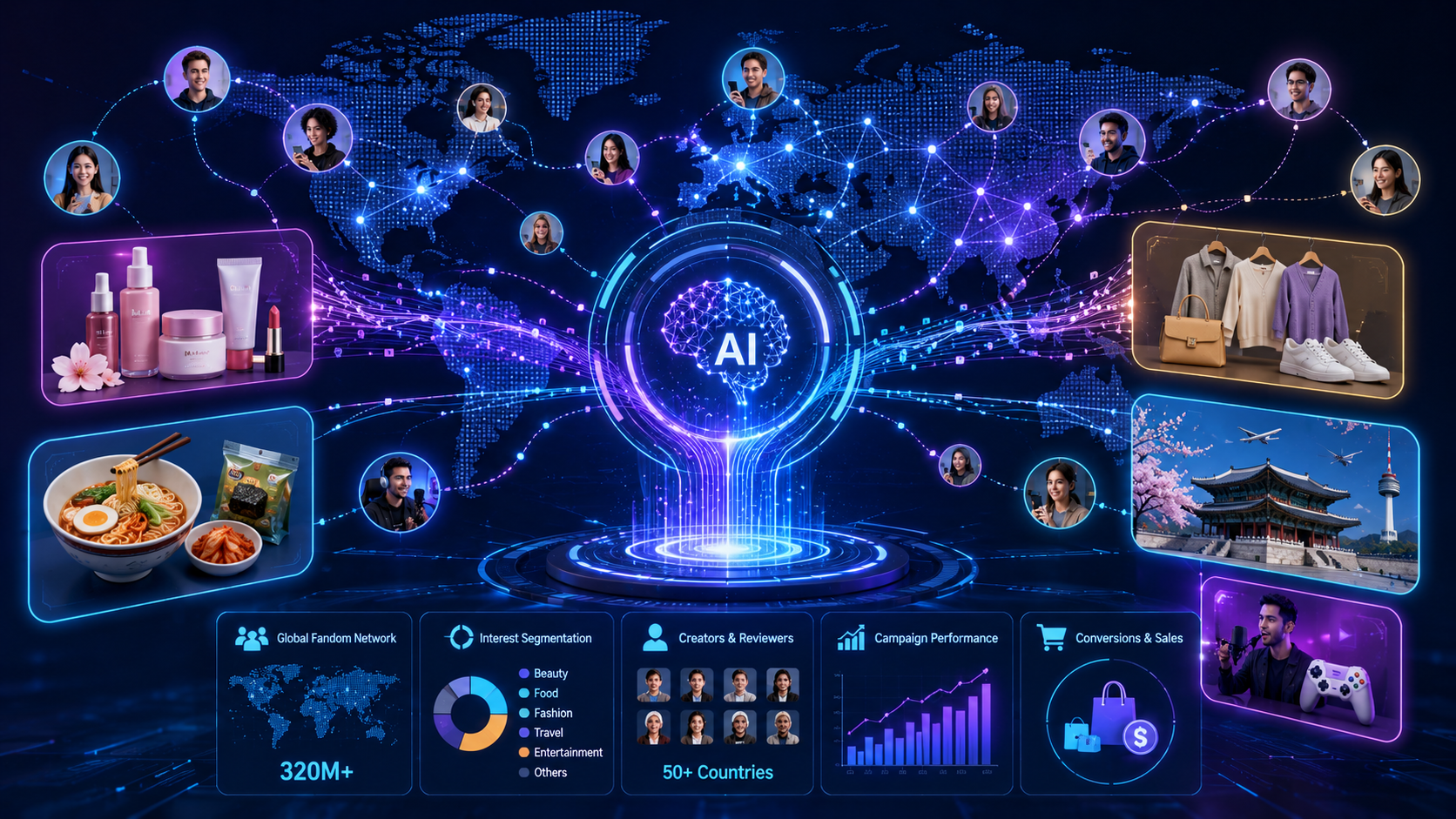
KGNC says its system collects, classifies, cleans and processes global Korean Wave fandom data before using AI to identify groups of consumers and creators that may fit a brand’s characteristics.
For example, someone primarily interested in Korean skincare may be more relevant to a cosmetics campaign than a general K-pop fan.
A consumer interested in Korean food could be more useful to a food exporter.
Someone planning a trip to South Korea might be a strong candidate for a tourism, hospitality or in-person brand experience campaign.
Traditional international influencer marketing often requires marketing teams to search manually through social media accounts and communities.
Employees identify potential creators, contact them through direct messages or email, negotiate participation, manage schedules and monitor whether agreed content is delivered.
Doing this across several countries creates additional complications.
Languages differ.
Social platforms differ.
Consumer interests differ.
Creator pricing differs.
Even the definition of an effective influencer can change significantly from one market to another.
KGNC is attempting to automate part of that discovery and management process.
AI Could Make Global Audience Matching More Precise
AI is particularly suited to classification problems involving large datasets.
Marketing teams have always segmented customers.
What is changing is the volume of information that can potentially be analyzed.
A conventional marketer might divide customers by age, location or gender.
Modern digital platforms can incorporate much richer signals, including interests, content engagement, previous campaign activity and community affiliation.
AI systems can potentially identify combinations that would be difficult for a human analyst to find manually.
In Koconet’s case, the objective is to determine which international Korean Wave consumers are most relevant to a particular Korean brand.
That could make fandom a more structured marketing resource rather than simply a broad measure of cultural popularity.
Koconet Says Its Network Reaches 120 Countries
KGNC says Koconet is connected with approximately 1,750 Korean Wave clubs across 120 countries, with the broader associated fandom network representing about 320 million people.
The company’s current website similarly describes KGNC as connecting Korean brands with consumers through a Korean Wave network spanning roughly 120 countries and about 320 million people.
Those numbers should be understood as company-reported network figures rather than independent measurements of active Koconet users.
That distinction matters.
A network’s theoretical reach can be much larger than the number of people actively using a particular platform.
For marketers, the more important measurements ultimately include active participation, campaign response, conversion rates and sales.
Nevertheless, access to organized fandom communities could provide an interesting starting point for international campaigns.
K-Brand Marketing Has a Discovery Problem
The Korean Wave has become a powerful gateway for Korean products.
Consumers who discover Korean music or television may later become interested in Korean beauty products, food, fashion, travel and other aspects of Korean culture.
But brands still need to identify which consumers are likely to care about a particular product.
A small cosmetics manufacturer cannot efficiently market to hundreds of millions of people.
Neither can a regional food company.
The challenge is finding the portion of the global fandom that has relevant interests and purchasing potential.
This is where Koconet AI marketing is positioned.
Instead of asking, “Who likes Korean culture?” the system attempts to answer a narrower question:
“Which people within that audience are likely to care about this specific Korean brand?”
That is a much more commercially useful problem.
K-Beauty Is a Natural Use Case
K-beauty provides a clear example.
The international cosmetics market contains enormous numbers of creators and consumers.
But beauty itself is highly segmented.
Consumers may focus on skincare, makeup, haircare or professional cosmetics.
Some are interested in premium products.
Others prioritize affordability.
Some consumers follow Korean beauty trends closely, while others discover products through broader lifestyle content.
An AI-driven marketing platform could theoretically use those differences to identify consumers whose interests align more closely with a specific product.
KGNC says creators and product-experience participants registered through Koconet can receive collaboration opportunities according to areas including beauty, food, fashion and medical-related interests.
For brands, that could reduce the amount of manual audience screening required before a campaign begins.
K-Food Could Benefit From Local Communities
Food presents a different challenge.
Taste is strongly influenced by geography and culture.
A Korean food product that performs well in one country may require a different marketing strategy elsewhere.
Local creators can provide context that global advertising often lacks.
They know which recipes appeal to their audiences.
They understand local shopping behavior.
They communicate in the local language.
They can also explain unfamiliar products in a way that feels accessible.
A fandom-based platform can potentially connect Korean food companies with people who already have some interest in Korean cuisine or culture.
That creates a warmer starting audience than completely untargeted advertising.
Product Experience Campaigns Turn Consumers Into Media
One of KGNC’s major services involves overseas product experience campaigns.
The company’s official site describes programs where foreign consumers receive or purchase Korean products, use them and publish reviews through social media, blogs or communities.
This approach combines several marketing functions.
The consumer becomes a product tester.
The review becomes marketing content.
The creator’s audience becomes a distribution channel.
And the resulting posts can create social proof for future customers.
For smaller Korean brands without large international advertising budgets, that model can be attractive.
Instead of purchasing broad advertising exposure, they can focus resources on consumers already connected to relevant communities.
Influencer Size Is Not Everything
AI-based creator matching could also challenge the assumption that bigger influencers are always better.
A creator with one million followers may generate enormous reach.
But if only a tiny fraction of those followers care about a product category, the campaign may produce weak commercial results.
A creator with 20,000 highly relevant followers could potentially deliver better engagement.
This is why modern influencer marketing increasingly focuses on audience fit rather than follower count alone.
The best creator for a campaign is not necessarily the largest creator.
It is the creator whose audience overlaps most strongly with the brand’s likely customers.
Koconet’s patented segmentation approach is intended to improve this matching process.
AI Can Reduce Manual Creator Discovery
Creator discovery can consume significant amounts of marketing time.
A marketer may search social platforms for hours.
Potential partners need to be evaluated.
Their content needs to be reviewed.
Audience characteristics need to be understood.
The company then needs to contact them.
Many will not respond.
Others may not be available.
Some may demand compensation beyond the campaign budget.
When this process is repeated across multiple countries, the operational burden increases quickly.
KGNC says one objective of its AI approach is to reduce the time and cost required to identify appropriate overseas creators and experience-group participants.
Automation cannot remove relationship management entirely.
Influencer marketing remains a human business.
But it can potentially reduce the amount of repetitive work required before a relationship begins.
The Platform Combines Web and Mobile Functions
Koconet uses both web and mobile components.
According to KGNC, the web platform supports brand registration, campaign management, recruitment of creators and product testers, contracts and advertising-effect analysis.
The mobile side focuses more heavily on communication with Korean Wave communities and fans, promotion and content distribution.
This separation makes sense.
Brands need management tools.
Consumers need a simple participation environment.
Creators need information about campaigns.
Marketing operators need performance data.
Bringing those functions together could reduce reliance on spreadsheets, direct messages, email chains and separate contract-management tools.
KGNC says recruitment, management, campaign execution and contracts can be handled through a single channel.
Global Marketing Is Becoming a Data Problem
The larger trend behind Koconet is the transformation of marketing into a data problem.
International marketing once depended heavily on agencies, local distributors and traditional media buying.
Those channels remain important.
But digital platforms provide substantially more information about audiences.
Marketers can now analyze which content attracts attention.
They can identify communities.
They can track engagement.
They can measure clicks.
In some cases, they can connect campaigns directly with transactions.
AI adds another layer by helping companies analyze those datasets more quickly.
The result is a transition from broad demographic targeting toward increasingly specific audience models.
Fandom Data Could Be Valuable for Korean SMEs
This could be especially relevant for Korean small and medium-sized businesses.
Large consumer companies can establish overseas offices and hire local marketing agencies.
Smaller businesses often cannot.
A Korean skincare startup may have a strong product but little understanding of the Indonesian, French or Brazilian creator markets.
A food manufacturer may know that demand for Korean cuisine is growing but have no direct relationships with local communities.
A tourism business may want foreign visitors but lack the resources to operate multilingual campaigns.
Platforms such as Koconet attempt to reduce that information gap by providing access to pre-organized international communities.
KGNC says it is also running promotional pricing intended to reduce international marketing costs for smaller companies.
K-Culture Creates a Cross-Selling Opportunity
The Korean Wave is commercially interesting because cultural interest can extend across product categories.
Someone who watches Korean dramas may become interested in Korean food.
A K-pop fan may discover Korean cosmetics.
A beauty consumer may eventually become interested in visiting Seoul.
A traveler may purchase Korean products after returning home.
These relationships create what marketers might describe as adjacent interests.
Fandom platforms can potentially map those relationships.
Instead of viewing K-pop, K-beauty, K-food and K-tourism as isolated industries, marketers can analyze them as parts of a broader cultural consumption ecosystem.
That could make fandom data particularly useful.
But AI Matching Does Not Guarantee Sales
There is an important limitation.
Finding a relevant audience does not guarantee commercial success.
AI can help identify consumers who appear likely to be interested.
It cannot make an unattractive product successful.
Pricing still matters.
Product quality matters.
Shipping costs matter.
Localization matters.
Regulatory compliance matters.
Customer service matters.
Brand reputation matters.
A campaign may reach exactly the right consumer and still fail because the product is too expensive in that market.
For this reason, Koconet’s AI matching should be understood as a marketing tool rather than a guarantee of overseas expansion.
The patent establishes intellectual-property protection around the system described by KGNC; it does not independently prove that AI-targeted campaigns will outperform every alternative marketing method.
Data Quality Will Determine AI Quality
Another important issue is data quality.
AI recommendations are only as useful as the information behind them.
If consumer profiles are incomplete, recommendations may be weak.
If users incorrectly describe their interests, targeting can become less accurate.
If a community is inactive, theoretical network size may provide little practical marketing value.
The system therefore needs continuous information about audience interests and campaign participation.
This principle applies far beyond Koconet.
Across the AI industry, companies are discovering that better algorithms alone do not solve poor-data problems.
High-quality classification requires high-quality signals.
For a fandom marketing platform, maintaining accurate interest and participation data could become one of its most important competitive assets.
Privacy Will Also Matter
Personalization inevitably raises privacy questions.
The more precisely a marketing system attempts to understand consumers, the more carefully it needs to manage data.
International platforms face an additional challenge because privacy requirements differ between jurisdictions.
Consumers should understand what information is collected and how it is used.
Companies also need appropriate consent, security and data-governance procedures.
KGNC’s announcement focuses primarily on the patented marketing architecture rather than providing a detailed analysis of international privacy compliance.
As Koconet expands internationally, data governance will therefore remain an important area to watch.
AI Marketing Is Moving Beyond Ad Targeting
The Koconet AI marketing model also illustrates how AI marketing is moving beyond conventional advertising.
AI is already widely used to determine which advertisements users see.
But creator marketing requires more complicated matching.
The platform is not simply matching an advertisement with a browser.
It is potentially matching a brand with a human creator or consumer participant who will then produce content.
That relationship involves interests, audience fit, geography, language and campaign requirements.
In this sense, AI becomes a business-matching engine rather than simply an advertising algorithm.
Human Relationships Still Matter
Even with better algorithms, successful creator campaigns require trust.
A creator needs to believe the product fits their audience.
The brand needs confidence that the creator will represent the product appropriately.
Consumers need to believe the resulting review is credible.
If every campaign feels automated and transactional, the authenticity that makes creator marketing effective can disappear.
The strongest use of AI may therefore be behind the scenes.
AI can identify candidates.
It can organize data.
It can rank potential matches.
Humans can then decide which relationships make sense.
This hybrid model preserves efficiency without removing judgment.
Korean Brands Are Competing for Global Attention
The timing of the patent also reflects increasing competition around Korean consumer brands.
International interest in Korean culture has opened markets that would have been much harder for smaller Korean companies to reach a decade ago.
But opportunity creates competition.
More brands are targeting the same overseas consumers.
Advertising costs can rise.
Creator inboxes become crowded with sponsorship requests.
Consumers become more selective.
Under those conditions, precision matters more.
Sending the same message to millions of people may become less effective than identifying smaller communities with a genuine interest in the product.
Koconet Could Turn Fandom Into Marketing Infrastructure
KGNC’s longer-term opportunity is to transform Korean Wave fandom from an audience into infrastructure.
Its official website describes Koconet as a community and information-sharing platform covering interests such as K-pop, K-drama, K-food, K-travel and Korean-language study.
If those communities can also be connected with commercial campaigns, the platform can potentially operate between cultural fandom and cross-border commerce.
A user enters because they are interested in Korea.
They join communities around particular interests.
Those interests create segmentation data.
Brands use that information to identify potential campaign participants.
Consumers receive opportunities related to topics they already care about.
The resulting reviews and social content can then attract additional consumers.
That creates a potential feedback loop between community, data and marketing.
Patent Protection Gives KGNC an IP Asset
The newly registered patent gives KGNC an intellectual-property asset around its specific implementation of AI-based multidimensional fandom segmentation for global Korean Wave marketing.
Patent registration can matter for technology companies because it creates legal protection around claimed inventions.
It can also become relevant when attracting partners, investment or enterprise customers.
However, a patent should not be confused with market validation.
The commercial value will ultimately depend on whether businesses use the system and whether campaigns produce useful results.
The next important metrics will therefore be adoption and performance rather than patent registration alone.
Koconet AI Marketing Targets a Growing Opportunity
The broader significance of Koconet AI marketing is its attempt to connect three trends that have largely developed separately: artificial intelligence, the global Korean Wave and creator-driven commerce.
AI provides the segmentation technology.
Korean Wave communities provide the audience.
Creators and product testers provide the distribution layer.
Korean brands provide the commercial demand.
KGNC’s newly registered patent brings those components into a single marketing architecture designed to identify overseas consumers more efficiently.
The company says its network spans approximately 120 countries and is associated with around 320 million Korean Wave fans, while its platform provides programs involving overseas product trials, purchase reviews, influencer collaboration and experiences for foreign visitors to Korea.
Whether this model produces better commercial outcomes than conventional influencer marketing will require more performance evidence over time.
But the direction is clear.
Global fandom is becoming measurable data.
Creator discovery is becoming increasingly automated.
And Korean brands are looking for technology that can convert cultural interest into actual international customers.
Koconet’s latest patent is one attempt to build that bridge.