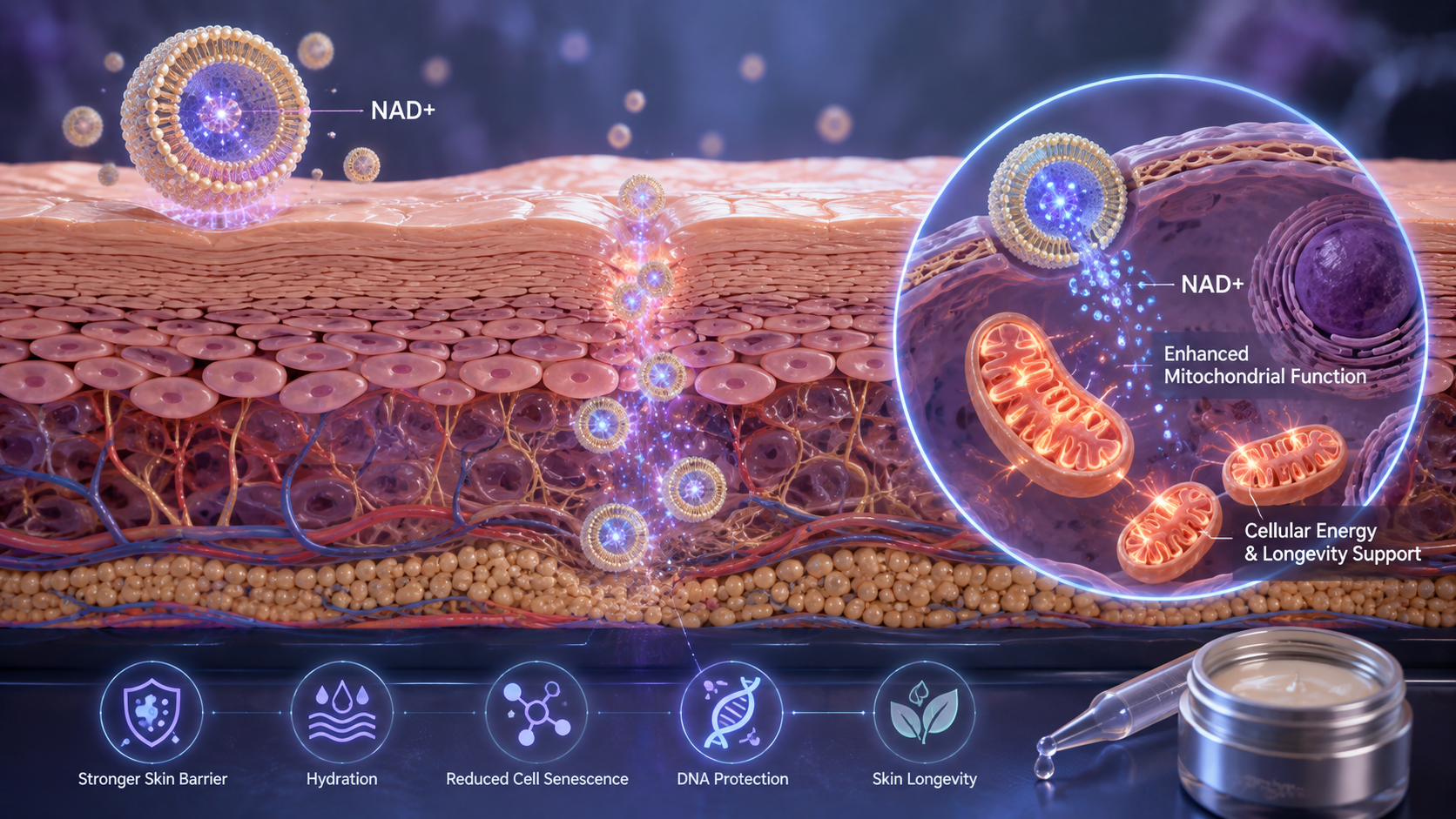

NAD+ skin delivery could become a new frontier in longevity-focused skincare after researchers in South Korea developed a nanovesicle platform designed to overcome one of the biggest obstacles to using nicotinamide adenine dinucleotide directly on skin: getting the molecule through the skin barrier in a stable and biologically accessible form.
Researchers from LG Household & Health Care and the Gwangju Institute of Science and Technology, or GIST, have reported an ion-coupled transfersome system that improves the stability and transdermal delivery of NAD+, a coenzyme involved in cellular metabolism, mitochondrial function and processes associated with aging.
The peer-reviewed research was published in Materials Today Bio, Volume 38, under the title “Ion-coupled transfersome complexes for enhanced transdermal NAD+ repletion and mitigation of cellular senescence signatures.” The paper was accepted in May 2026 and published in the journal’s June 2026 volume.
LG Household & Health Care is commercializing related technology under the name NAD Power24, according to its announcement.
The research is notable because NAD+ has attracted enormous attention in longevity science, but translating the molecule into practical topical applications is difficult.
NAD+ is highly hydrophilic and positively charged, characteristics that limit its ability to passively cross biological membranes and penetrate skin tissue. It is also vulnerable to stability and delivery problems.
The new system attempts to solve those limitations through a modified lipid vesicle that binds NAD+ ionically rather than simply encapsulating it inside a conventional carrier.
That distinction could be important for the rapidly expanding intersection of biotechnology, longevity science and premium skincare.
NAD+ Skin Delivery Faces a Biological Barrier
NAD+, or nicotinamide adenine dinucleotide, is present throughout living cells and participates in fundamental metabolic reactions.
It plays a particularly important role in cellular energy metabolism.
Mitochondria—the structures responsible for producing much of the usable energy inside cells—depend on NAD-related biochemical pathways.
NAD+ is also connected with enzymes involved in DNA repair, stress responses and cellular regulation.
This has made NAD+ metabolism a major subject of aging research.
But recognizing the biological importance of a molecule is very different from successfully delivering it to the location where it is intended to act.
For skincare, the first obstacle is the skin itself.
Human skin is designed to keep substances out.
Its outermost layers provide an effective protective barrier against environmental chemicals, microorganisms and water loss.
That barrier is essential for survival, but it creates a major challenge for topical drug and cosmetic development.
The published study notes that the hydrophilic and positively charged nature of NAD+ makes passive transport across biological membranes difficult.
This means simply placing NAD+ into a cream does not automatically ensure that meaningful amounts will reach deeper skin tissue.
Researchers Developed an Ion-Coupled Transfersome
To address the delivery problem, the researchers developed what they call an Ion-Coupled NAD+ Transfersome, abbreviated ICoN.
Transfersomes are flexible lipid-based vesicles designed to deform as they move through biological barriers.
The new approach changes how NAD+ interacts with the carrier.
Rather than relying only on conventional encapsulation, the system ionically couples NAD+ to components of the lipid vesicle.
According to the published paper, the platform uses hydrogenated lecithin, cholesterol, sodium stearoyl glutamate and sorbitan oleate, with NAD+ ionically coupled to the vesicle structure.
The objective is twofold.
First, the carrier needs to stabilize NAD+.
Second, it needs to improve delivery into skin tissue.
The study reported evidence supporting both functions in experimental models.
Human Skin Explants Were Part of the Study
One of the more significant aspects of the research is that the experiments were not limited to isolated cultured cells.
Researchers also evaluated the technology using ex vivo porcine and human skin explants.
According to the peer-reviewed paper, ICoN produced greater intratissue NAD+ penetration than free NAD+ or precursor approaches tested in the study and reduced molecular signatures associated with cellular senescence.
Human skin explants provide a more realistic tissue environment than individual cells grown in a dish.
They preserve more of the physical structure and biological complexity of actual skin.
However, they are still not equivalent to a clinical trial involving people using a finished skincare product over time.
That distinction is essential when interpreting the results.
The study provides promising mechanistic and preclinical evidence.
It does not establish that topical NAD+ technology reverses visible human aging in everyday consumer use.
NAD+ Increased Inside Cells
The researchers also examined whether the delivery system could restore intracellular NAD+.
The study reported that ICoN increased intracellular NAD+ levels and affected transcriptomic pathways associated with DNA damage, oxidative stress and cellular senescence.
These observations are important because simply detecting NAD+ near the surface of the skin would not demonstrate successful biological delivery.
The goal is to make NAD+ available where cells can potentially use it.
Researchers therefore examined biological responses after delivery.
The results indicated improvements in mitochondrial functional integrity and maintenance of proliferative and migratory capacity under experimental conditions involving cellular senescence and NAD+ depletion.
This provides a mechanistic link between delivery and cellular function.
Mitochondria Are Central to the Research
Mitochondria are frequently described as the powerhouses of cells, but their role extends beyond simply generating energy.
They participate in cellular signaling, stress responses and metabolic regulation.
Mitochondrial dysfunction is also associated with aging.
As cells experience repeated environmental stress, mitochondrial performance can deteriorate.
That deterioration can contribute to oxidative stress and other changes associated with cellular senescence.
Because NAD+ is deeply involved in cellular energy metabolism, researchers have been studying whether maintaining NAD+ availability can support healthier cellular function.
LG Household & Health Care says its NAD Power24 technology increased NAD+ delivery and helped restore mitochondrial function in experimental skin models.
The peer-reviewed paper similarly reports improvements in mitochondrial functional integrity under its experimental conditions.
UV-Damaged Skin Was Also Examined
Ultraviolet radiation is one of the most important external drivers of visible skin aging.
Repeated UV exposure can damage DNA, increase oxidative stress and alter the extracellular structures that support healthy skin.
Researchers therefore used UV-stressed human skin as part of the investigation.
The study combined high-resolution spatial transcriptomics with bulk transcriptomic analysis to examine how different areas of skin tissue responded to treatment.
The researchers reported that ICoN reduced histological disruption and transcriptional signatures associated with cellular senescence in UV-stressed human skin models.
Spatial transcriptomics is particularly interesting in this context.
Traditional molecular analysis can reveal which genes are active in a tissue sample.
Spatial methods add information about where those molecular changes occur within the tissue.
That can give researchers a more detailed picture of how a treatment affects different regions and cell populations.
Spatial Biology Is Entering Beauty R&D
The use of spatial transcriptomics also illustrates how advanced biotechnology is entering cosmetics research.
Beauty research historically relied heavily on physical measurements, imaging and relatively straightforward biochemical assays.
Modern skincare R&D increasingly incorporates technologies developed in biomedical research.
Genomics can measure gene activity.
Proteomics can examine proteins.
Metabolomics can analyze cellular metabolites.
High-resolution imaging can track structural changes.
AI can identify patterns across large biological datasets.
Spatial transcriptomics adds another layer by preserving information about where molecular activity occurs.
These technologies can help cosmetic companies move from broad claims about moisturization or appearance toward much more detailed explanations of biological mechanisms.
That does not automatically make every product claim clinically meaningful.
But it substantially changes the scientific toolkit available to the industry.
The Study Also Used C. elegans
The researchers extended their investigation beyond skin models.
The paper reports experiments involving Caenorhabditis elegans, a microscopic roundworm commonly used in aging research.
ICoN treatment was associated with increased lifespan and improved healthspan measures in the organism under the experimental conditions.
C. elegans is widely used because its short lifespan allows scientists to investigate aging processes much more rapidly than would be possible in humans.
However, results in worms cannot be directly translated into claims about human lifespan.
The value of the model is primarily mechanistic.
It allows researchers to examine biological pathways related to aging and test whether interventions affect those pathways in a whole living organism.
For a consumer skincare story, this distinction is particularly important.
The research should not be interpreted as evidence that NAD+ cosmetics extend human lifespan.
Cellular Lifespan Is Not Human Lifespan
LG Household & Health Care’s announcement also says treated skin cells showed an increase in survival period from approximately 30 days to 55 days under its experimental conditions.
That is an interesting laboratory observation, but the wording requires context.
A longer survival period for cells in an experimental model is not equivalent to a person living longer.
It also does not mean a consumer’s skin literally becomes decades younger.
Cellular aging, tissue aging and organism-level aging are related but very different levels of biology.
This is why peer-reviewed experimental evidence needs careful interpretation when translated into consumer-facing skincare claims.
The most defensible conclusion is that the researchers observed changes in experimental models associated with improved NAD+ availability, mitochondrial function and reduced senescence signatures.
The “30-Year-Old Skin” Claim Needs Context
The company announcement states that when NAD Power24 was applied to skin tissue from people in their 60s, aging indicators shifted toward levels associated with skin from people in their 30s.
That is an attention-grabbing result.
But it should not be interpreted as evidence that applying a cosmetic product makes a 60-year-old person’s skin biologically identical to that of a 30-year-old.
The experiments involved skin tissue and molecular or histological indicators.
Human aging is multidimensional.
Visible wrinkles, elasticity, pigmentation, hydration, barrier function, tissue structure and molecular markers do not necessarily change together.
Clinical validation would therefore be needed before making broad conclusions about visible rejuvenation in consumers.
For an evidence-based interpretation, the result is better described as a reversal of certain aging-associated signatures in experimental skin tissue.
Why NAD+ Is Attracting Beauty Companies
The beauty industry has historically moved through successive generations of anti-aging ingredients.
Retinoids became important because of their effects on skin renewal and collagen-related pathways.
Antioxidants targeted oxidative stress.
Peptides attempted to influence signaling pathways.
More recently, the industry has adopted concepts from longevity biology.
Terms such as cellular senescence, mitochondrial health, autophagy, epigenetics and NAD+ metabolism are increasingly appearing in skincare research.
This reflects a change in how companies define anti-aging.
Rather than focusing only on correcting visible wrinkles, some brands are positioning products around maintaining cellular function for longer.
The emerging phrase is skin longevity.
Skin Longevity Is Becoming a Beauty Trend
Skin longevity differs subtly from traditional anti-aging marketing.
Anti-aging often focuses on reversing signs that have already appeared.
Longevity-oriented skincare emphasizes maintaining healthy skin function over a longer period.
The distinction partly mirrors the broader longevity movement in medicine and biotechnology.
Instead of treating diseases only after they appear, longevity research often focuses on biological mechanisms that change during aging.
Beauty companies are adapting similar language.
Mitochondrial health becomes relevant.
Cellular senescence becomes relevant.
DNA damage becomes relevant.
Metabolic cofactors such as NAD+ become relevant.
LG Household & Health Care CTO Nae-Gyu Kang described the company’s work as a “skin longevity” technology aimed at improving skin energy and resilience through direct NAD+ delivery.
NAD+ Is Already a Major Longevity Research Target
NAD+ research extends far beyond cosmetics.
Scientists have studied NAD+ metabolism in relation to aging, metabolic disorders, mitochondrial biology and other areas.
The molecule is involved in redox reactions essential for cellular metabolism and serves as a substrate for several classes of enzymes involved in cellular regulation.
NAD+ levels and metabolism can change with aging and disease.
This has led to substantial interest in compounds that influence NAD+ availability.
Some strategies use NAD+ precursors rather than NAD+ itself.
Others attempt to reduce NAD+ consumption.
LG’s approach is different because it focuses on delivering NAD+ directly into skin tissue through a specialized carrier.
That makes delivery technology central to the commercial proposition.
Delivery Technology Could Matter More Than the Ingredient
The skincare industry often focuses on ingredients.
Consumers recognize retinol, vitamin C, hyaluronic acid and peptides.
But the effectiveness of a topical formulation can depend heavily on how an ingredient is delivered.
A biologically interesting molecule is not automatically a useful cosmetic ingredient.
It must remain stable during manufacturing and storage.
It needs to survive inside the formulation.
It needs to reach an appropriate location in the skin.
And it needs to remain available at a useful concentration.
This is why delivery technologies such as liposomes, nanoparticles and other vesicle systems are important.
For NAD+, delivery may be particularly challenging because of the molecule’s physical and chemical characteristics.
The ICoN platform attempts to turn NAD+ from an interesting biological molecule into something more practical for topical application.
LG Has Been Building NAD+ Research
The 2026 paper is not LG Household & Health Care’s first published work involving NAD+ and skin aging.
LG researchers previously published a 2024 study investigating the effects of exogenous NAD+ combined with inhibition of CD38 expression.
That paper appeared in the journal Cells and examined approaches to increasing cellular NAD+ and influencing aging-related biological processes.
The newer research moves the problem toward delivery.
Instead of focusing only on whether NAD+ can influence biological pathways, it asks how the molecule can actually be delivered through skin tissue.
That progression is important commercially.
Ingredient discovery is only one stage of product development.
Formulation and delivery often determine whether laboratory science can become a usable consumer product.
LG Plans Commercial Applications
LG Household & Health Care says it has secured key patents related to NAD Power24 and is applying the technology to ingredient development.
The company also says the technology is being used in the Bichup line of its luxury beauty brand The Whoo.
This illustrates the increasingly short distance between biotechnology research and premium cosmetics.
A technology can begin in cell biology.
Researchers develop a delivery system.
Mechanisms are tested in tissue models.
Patent protection is secured.
The technology then moves into a commercial skincare formulation.
For beauty companies, proprietary science can also become part of brand differentiation.
Premium products compete not only on packaging and brand heritage but increasingly on patented ingredients and published research.
Peer Review Adds Evidence, Not Certainty
Publication in a peer-reviewed scientific journal gives the research greater credibility than an unsupported marketing claim.
The paper is indexed in PubMed, carries DOI 10.1016/j.mtbio.2026.103218, and lists researchers from LG Household & Health Care, GIST and other academic institutions.
However, peer review should not be confused with final clinical proof.
The paper’s conflict-of-interest statement notes that multiple authors are employees of LG Household & Health Care.
That does not invalidate the research.
Industry scientists routinely conduct legitimate peer-reviewed research.
But commercial involvement is relevant context when evaluating claims.
Independent replication and well-designed human clinical trials would provide additional evidence.
Human Clinical Data Is the Next Big Question
The most important unanswered question is how the technology performs in living human users over time.
Ex vivo human skin provides useful biological evidence.
But living skin is part of a much more complicated system.
Blood flow, immune responses, environmental exposure, skincare routines and individual biological differences can all influence outcomes.
A robust clinical study could examine endpoints such as wrinkles, elasticity, hydration, pigmentation, barrier function and tolerability.
It could compare NAD+ delivery technology with placebo formulations or established active ingredients.
Longer studies could determine whether improvements persist.
Until those data are available, claims should remain aligned with what the current experiments actually demonstrate.
NAD+ Skin Delivery Could Reshape Premium Skincare
The larger significance of NAD+ skin delivery is not that one study has solved human skin aging.
It has not.
The significance is that longevity biology is increasingly moving into practical consumer technology.
Researchers are no longer studying only whether NAD+ matters biologically.
They are engineering nanoscale delivery systems specifically intended to overcome the molecule’s physical limitations.
The LG Household & Health Care and GIST study provides evidence that an ion-coupled transfersome can stabilize NAD+, improve penetration into experimental skin tissue and influence biological signatures associated with mitochondrial function and cellular senescence.
That is a more meaningful scientific development than simply adding NAD+ to a cosmetic ingredient list.
The delivery mechanism is the innovation.
If future human clinical trials confirm meaningful visible and functional benefits, NAD+ delivery systems could become an important category in premium longevity-focused skincare.
For now, the evidence supports a more measured conclusion.
NAD+ remains one of the most interesting molecules at the intersection of aging biology and beauty science, and researchers have developed a promising new way to get it into skin tissue.
Whether that ultimately translates into significant anti-aging benefits for consumers is the next question science will need to answer.