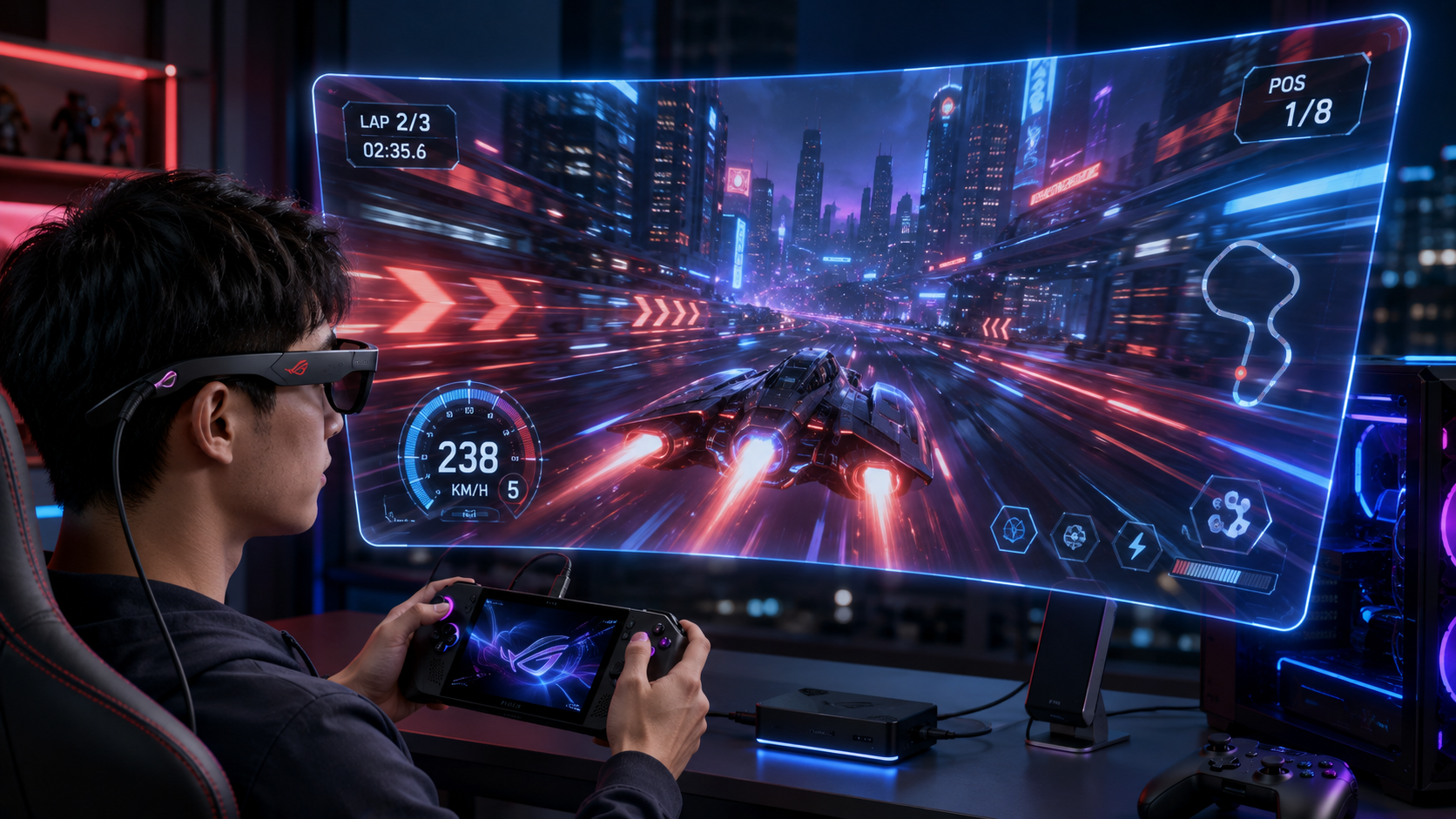

ROG XREAL R1 is bringing high-refresh-rate gaming into augmented reality as ASUS and XREAL push wearable displays closer to the performance traditionally expected from premium gaming monitors.
ASUS has launched the ROG XREAL R1 gaming AR glasses in South Korea, expanding availability of a device first introduced at CES 2026 and developed in partnership with AR hardware specialist XREAL. The glasses combine a Micro-OLED display system with refresh rates of up to 240Hz, a 0.01ms response time and a virtual display that can appear as large as 171 inches when viewed from four meters.
The product represents an interesting shift in gaming hardware.
Instead of placing a larger physical monitor on a desk, ROG and XREAL are attempting to put the equivalent of an enormous display directly in front of the player’s eyes.
That could have implications not only for AR gaming but also for handheld PCs, portable consoles and gamers who want a large-screen experience without carrying a conventional monitor.
ROG XREAL R1 Targets 240Hz Gaming
Refresh rate is one of the R1’s defining features.
ASUS describes the device as the world’s first 240Hz Micro-OLED gaming AR glasses. The displays provide Full HD 1920 × 1080 resolution and can reach 240Hz using the device’s Frame Rate Boost mode.
For gaming, refresh rate matters because it determines how frequently the display can update the image.
A conventional 60Hz screen refreshes 60 times per second.
At 120Hz, that doubles.
At 240Hz, the screen can update up to 240 times per second when the hardware and content pipeline support that rate.
Higher refresh rates can make motion appear smoother and can be particularly valuable in fast-paced games where rapid camera movement and precise visual tracking matter.
Competitive PC gamers have already moved toward 240Hz, 360Hz and even faster desktop monitors.
Bringing 240Hz into lightweight AR glasses therefore attempts to close one of the performance gaps between wearable displays and conventional gaming hardware.
There is an important qualification: XREAL notes that its 240Hz Frame Rate Boost mode uses FHD image scaling, which can slightly reduce sharpness compared with native-resolution operation.
Micro-OLED Makes Wearable Displays Possible
The ROG XREAL R1 uses Micro-OLED display technology.
OLED pixels generate their own light rather than relying on a conventional backlight.
That enables deep blacks and high contrast while allowing extremely compact display systems.
Micro-OLED takes those advantages into much smaller panels suitable for near-eye devices.
This matters because AR glasses have severe physical constraints.
A gaming monitor can contain a large panel, substantial cooling and a heavy enclosure.
Glasses cannot.
Every component needs to fit inside a device light enough to remain wearable.
XREAL lists the R1 at approximately 91 grams.
The challenge is therefore not simply producing a good image.
Manufacturers need to create a high-performance display while controlling weight, heat and power consumption.
A 171-Inch Screen Without a 171-Inch TV
Perhaps the most immediately understandable feature is the virtual screen size.
ASUS says the R1 can create the perception of a display measuring up to 171 inches at a four-meter viewing distance, combined with a 57-degree field of view.
That does not mean a physical 171-inch display exists inside the glasses.
Optics create a virtual image that appears to occupy a large area in the user’s field of view.
This is one of the fundamental advantages of wearable display technology.
Physical screen size becomes less relevant.
A person sitting on a train, in a hotel or at a small desk can potentially experience something resembling a large display without transporting one.
For gaming, that can turn a handheld PC into something closer to a portable theater.
ROG Ally Integration Is Central
ASUS has designed the glasses to integrate particularly closely with the ROG Ally ecosystem.
A compatible ROG Ally can connect to the R1 through a single USB-C cable, creating a plug-and-play large-screen setup.
This combination addresses an inherent compromise in handheld gaming PCs.
Portable gaming systems need small screens because the entire device must remain compact.
But modern PC games often benefit from larger displays.
Text can be small.
Interfaces can become crowded.
Cinematic games benefit from scale.
AR glasses provide one possible solution.
The handheld continues performing the computation and running the game, while the glasses become the display.
This allows the player to retain portability without being restricted to the physical screen built into the handheld.
Dual Displays Could Change Handheld Gaming
The integration goes further than simply mirroring a display.
According to ASUS Korea, players can use the large virtual screen through the R1 while retaining the ROG Ally’s physical display for controls and adjustments.
Brightness, virtual screen size and 3D settings can be changed without leaving the game.
This creates an interesting dual-screen configuration.
The glasses become the primary gaming screen.
The handheld becomes both the gaming computer and a secondary control interface.
That could become an important design model for portable gaming.
Rather than trying to make handheld screens continuously larger, manufacturers can treat wearable displays as optional extensions.
3DoF Keeps the Virtual Screen in Place
The R1 also supports native three-degrees-of-freedom, or 3DoF, spatial tracking.
This tracks rotational movement of the user’s head.
ASUS uses the technology for its Anchor mode, which allows the virtual display to remain fixed at a position in the surrounding environment.
Without spatial anchoring, a virtual screen can simply follow the user’s head movements.
Look left and the screen moves left.
Look right and it moves right.
That can be useful in some circumstances, but it does not feel like looking at a physical monitor.
Anchor mode changes the experience.
The screen can remain in one location.
The user can turn away from it and then look back.
This creates a stronger sense that the display occupies actual space.
AR Glasses Are Not the Same as VR Headsets
The distinction between AR glasses and virtual-reality headsets is important.
VR headsets are generally designed to immerse the user in a completely virtual environment.
They typically block most or all of the real world.
AR glasses preserve more awareness of the surrounding environment while placing digital imagery within the user’s view.
That makes devices such as the R1 more comparable to wearable monitors than traditional VR headsets.
The user can play a conventional PC or console game.
The game itself does not necessarily need to be designed for AR.
The glasses primarily transform how the display is presented.
This lowers a major adoption barrier.
Consumers do not need to wait for an entirely new library of AR-native games.
2D Games Can Become 3D
The R1 nevertheless includes a more experimental spatial feature.
ASUS says the glasses support real-time 2D-to-3D conversion, allowing conventional 2D content to gain stereoscopic depth.
This is potentially significant because content availability has historically limited 3D display technologies.
Consumers are unlikely to purchase hardware if very little compatible content exists.
Real-time conversion attempts to solve the problem computationally.
Instead of requiring every game developer to produce a dedicated stereoscopic version, the display system can transform existing content.
The quality of that experience will ultimately depend on the game and conversion implementation.
But strategically, it expands the amount of content that can potentially benefit from the hardware.
Electrochromic Lenses Adapt to the Environment
Another unusual feature is the use of electrochromic lenses.
Electrochromic materials can change transparency when an electrical signal is applied.
In the R1, that allows the glasses to adjust how much of the surrounding environment remains visible.
ASUS says lens transparency can change automatically according to viewing conditions, while users can also select manual tint levels.
This helps solve an optical problem.
Virtual images often become easier to see against darker backgrounds.
But permanently dark glasses reduce awareness of the real world.
Variable transparency allows the hardware to move between those conditions.
When the player focuses on the virtual display, the lenses can darken.
When looking away, they can become more transparent.
Bose Audio Adds Spatial Sound
ASUS and XREAL have also integrated Sound by Bose technology.
The objective is to create a spatial soundstage that complements the large virtual display.
Audio is particularly important in gaming.
Visual information tells players what is happening in front of them.
Sound can indicate what is happening outside their field of view.
Footsteps can reveal an approaching opponent.
Engine noise can help a racing player understand nearby vehicles.
Environmental sound contributes to immersion.
Combining near-eye visuals with spatial audio therefore makes sense.
The device is attempting to replace more than a monitor.
It is trying to create a portable audiovisual gaming environment.
The ROG Control Dock Expands Compatibility
The R1 is not limited to handheld gaming.
ASUS includes the ROG Control Dock to connect the glasses with broader gaming hardware.
The dock provides two HDMI 2.0 inputs and DisplayPort 1.4 connectivity, allowing users to connect PCs and game consoles and switch between sources.
This substantially broadens the product’s role.
A user could connect a desktop PC at home.
A console could use the same wearable display.
A handheld PC could connect directly through USB-C while traveling.
In effect, the glasses become a display that follows the player rather than being tied to one device.
DisplayWidget Center Brings PC Controls
PC users also gain access to ASUS DisplayWidget Center.
The software provides controls for display behavior and spatial layouts through a keyboard and mouse.
ASUS Korea says users can also access GamePlus functions including an AI-based crosshair and timers.
Software integration will be important to whether AR gaming glasses become mainstream.
Hardware specifications can attract early adopters.
Convenience determines whether people continue using the product.
If changing display size, position or transparency requires complicated menus, users may return to conventional monitors.
If those functions feel as straightforward as adjusting a desktop display, wearable screens become more practical.
AR Gaming Could Solve the Space Problem
One of the strongest arguments for gaming AR glasses has little to do with futuristic computing.
It is simply space.
A large gaming monitor requires a large desk.
A television requires a room.
Multiple monitors require even more space.
Not every gamer has that environment.
Students may live in small apartments.
Travelers may spend significant time in hotels.
Some players share living spaces.
A wearable virtual display can create a large perceived screen without consuming physical space.
That could make AR displays attractive in densely populated cities and other environments where large monitors are inconvenient.
Portable Gaming Is Becoming a Major Hardware Category
The timing also aligns with the growth of handheld PC gaming.
Devices such as the ROG Ally have demonstrated demand for portable access to PC game libraries.
But handheld design always involves compromise.
A larger display improves immersion but makes the device less portable.
A smaller display improves portability but reduces visual scale.
AR glasses separate those two variables.
The computing device can remain compact.
The perceived display can become enormous.
If wearable display technology continues improving, this could influence how future handheld PCs are designed.
Manufacturers may no longer need to treat the built-in display as the only way users will experience the device.
AR Glasses Compete With Portable Monitors
The R1 also competes indirectly with portable monitors.
Travelers sometimes carry thin external screens to create a larger workspace or gaming setup.
AR glasses offer a different approach.
They occupy less luggage space.
They can create a much larger virtual screen.
They also provide more privacy because nearby people cannot easily see the content.
However, conventional monitors still have advantages.
They can be viewed by multiple people.
They do not need to be worn.
They do not introduce the comfort issues associated with glasses.
This means AR glasses are unlikely to replace every portable monitor.
Instead, they create another display category.
Comfort Will Determine Long-Term Adoption
Specifications alone cannot determine the success of wearable displays.
Comfort may be equally important.
A monitor sits on a desk.
AR glasses sit on the user’s face.
Weight distribution matters.
Nose pressure matters.
Heat matters.
Eye comfort matters.
Prescription-lens compatibility matters.
Even a technically impressive display becomes difficult to use if the wearer wants to remove it after 30 minutes.
At approximately 91 grams, the R1 is dramatically lighter than typical VR headsets, but it is still heavier than ordinary eyewear.
Long gaming sessions will therefore provide an important real-world test.
240Hz Also Raises Performance Questions
A 240Hz display creates another consideration: the gaming hardware must generate frames quickly enough to take full advantage of it.
Running a demanding modern PC game at 240 frames per second can require substantial computing power.
Handheld gaming systems face even tighter thermal and power limitations.
The R1’s 240Hz capability therefore does not mean every connected game will run at 240fps.
Less demanding esports titles are more likely to approach extremely high frame rates.
Graphically intensive games may operate at substantially lower rates.
The value of the display is that it provides the capability when the source hardware and content can use it.
The 171-Inch Figure Also Needs Context
The same applies to the 171-inch specification.
Virtual display size depends on how perceived size and viewing distance are defined.
ASUS specifies the maximum as the equivalent of a 171-inch screen viewed at four meters.
That should not be interpreted as identical to owning a physical 171-inch television.
A physical display exists in a shared environment and can be viewed from different positions.
A virtual display exists only for the person wearing the glasses.
But for an individual user, the perceived scale can still provide a large-screen experience in a very small physical footprint.
Gaming Could Be AR’s Best Entry Point
Consumer AR has spent years searching for a compelling mainstream use case.
General-purpose augmented reality is technically ambitious.
A device that understands the environment, overlays information everywhere and operates all day requires sophisticated cameras, sensors, processors, batteries and software.
Gaming display glasses solve a narrower problem.
They do not need to replace a smartphone.
They do not need to understand every object in the room.
They primarily need to provide an excellent virtual screen.
That narrower objective may make gaming one of the more practical routes for AR adoption.
Consumers already spend significant amounts on premium monitors, GPUs, handheld gaming PCs and audio equipment.
A wearable display can fit naturally into that ecosystem.
ASUS and XREAL Bring Different Strengths
The collaboration itself is strategically interesting.
ASUS ROG brings a large gaming hardware ecosystem and an established audience of PC gamers.
XREAL specializes in lightweight XR hardware and optical systems.
The partnership therefore combines gaming-platform integration with AR display expertise.
XREAL describes the R1 as a result of its optical engineering working alongside the ROG ecosystem.
This type of partnership may become more common as AR matures.
Building compelling wearable displays requires expertise across optics, displays, industrial design, software and computing platforms.
Few companies dominate every layer.
Korea Launch Expands the R1 Market
The latest announcement specifically concerns South Korea.
ASUS Korea says sales are beginning through its official Naver store, with additional online and offline distribution planned.
The Korean market is particularly relevant for high-performance gaming products.
PC gaming, esports and premium hardware have strong consumer visibility in the country.
That makes Korea a logical market for a device positioned between gaming monitor and wearable AR hardware.
The R1 had already moved into global availability earlier in 2026, with ASUS and XREAL opening global preorders in May and worldwide shipping beginning in June.
The Korean launch therefore represents regional expansion rather than the product’s first global release.
ROG XREAL R1 Tests the Future of Displays
The ROG XREAL R1 ultimately asks a larger question about the future of personal displays.
Does a screen need to be a physical object?
For decades, display improvements meant buying a larger television or monitor.
Wearable displays change that equation.
The physical panel can become extremely small while optics make the perceived image enormous.
ASUS and XREAL are applying that idea specifically to gaming, combining a 240Hz Micro-OLED display, 0.01ms response time, 57-degree field of view, 3DoF spatial anchoring, 2D-to-3D conversion, electrochromic lenses and Bose audio in a wearable device.
The technology still faces practical challenges.
Comfort must be good enough for long sessions.
Image quality must compete with premium monitors.
Source hardware needs sufficient performance.
Consumers need to see enough value to justify adding another device to their gaming setup.
But the direction is increasingly clear.
AR glasses are evolving from experimental gadgets into specialized displays.
And gaming may be one of the first markets where the advantages of a private, portable and apparently enormous virtual screen are immediately understandable.
If that model succeeds, the next major gaming display may not sit on a desk at all.
It may be something players wear.