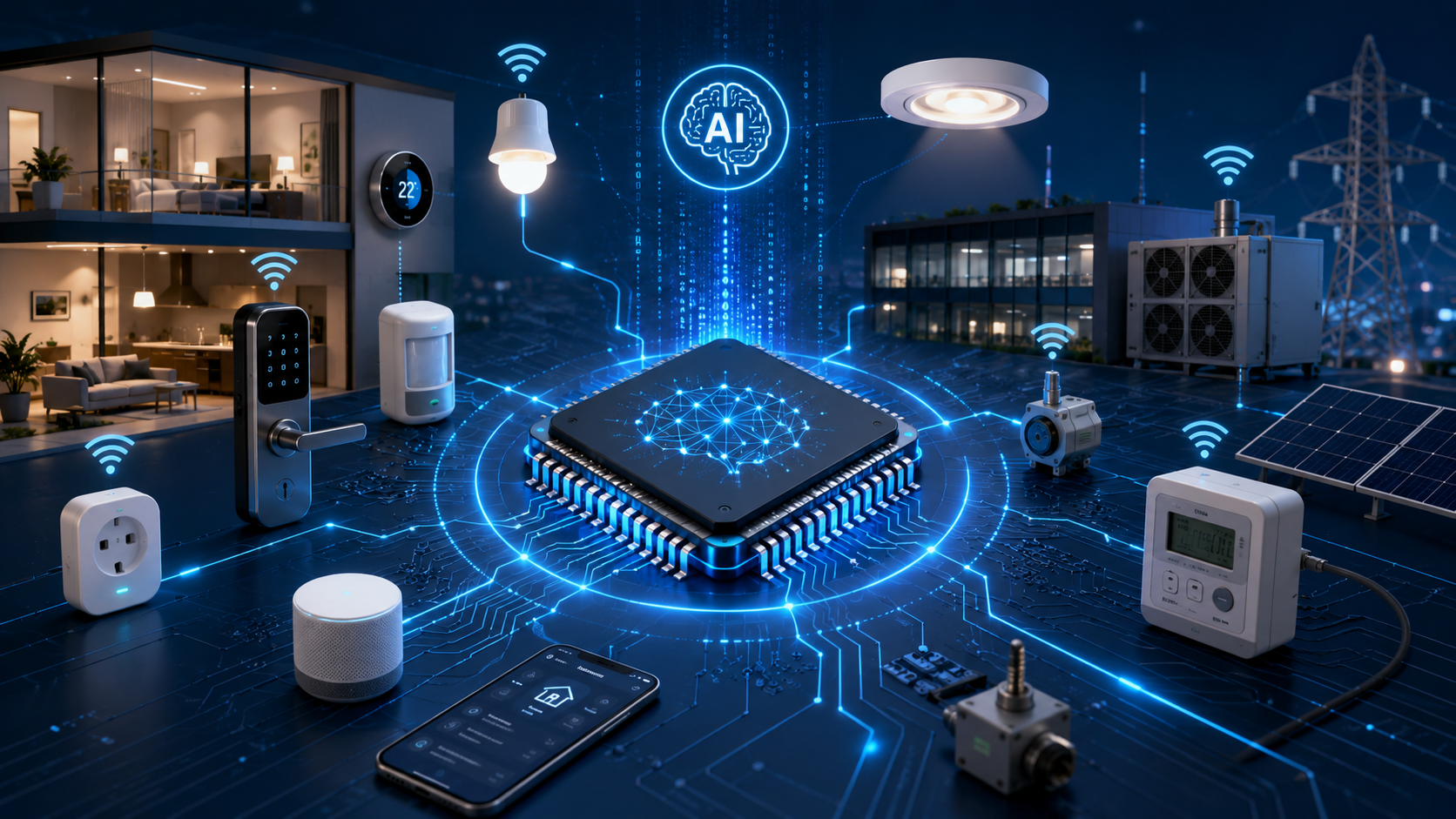

EFR32MG29 is bringing a new combination of wireless connectivity, security and edge AI capabilities to Internet of Things devices as manufacturers look for more intelligent hardware that can operate locally without depending entirely on cloud infrastructure.
Mouser Electronics is now distributing Silicon Labs’ EFR32MG29 wireless system-on-chip, expanding availability of a platform designed for connected products using protocols including Matter, Zigbee and Bluetooth Low Energy.
The device combines wireless connectivity with an Arm Cortex-M33 processor, dedicated security technologies and hardware designed to accelerate AI and machine-learning workloads.
That combination reflects an important change taking place across the IoT industry.
Connected devices were once designed primarily to collect information and send it somewhere else for processing. A sensor measured temperature, motion or another condition and transmitted the data to a gateway or cloud platform.
The next generation of IoT devices is becoming more capable.
Instead of functioning only as endpoints, devices can increasingly analyze information locally, make basic decisions and communicate only when necessary.
For smart homes, commercial buildings and industrial systems, this shift toward edge intelligence could improve responsiveness while reducing network traffic and cloud dependence.
EFR32MG29 Combines Wireless and AI
The EFR32MG29 belongs to Silicon Labs’ Series 3 wireless portfolio and is designed around an Arm Cortex-M33 processor.
Silicon Labs specifies CPU performance of up to 150 MHz, giving developers enough processing capability for increasingly sophisticated embedded applications while retaining the power characteristics required for many IoT products. Manual Machine
The processor is only one part of the platform.
The SoC also incorporates Silicon Labs’ Matrix Vector Processor, or MVP, which provides hardware acceleration for machine-learning workloads.
That means certain AI calculations can be performed using dedicated hardware instead of relying entirely on the general-purpose CPU.
This is particularly important for battery-powered devices.
Running machine-learning algorithms on a conventional processor can consume substantial energy.
Dedicated acceleration can perform supported workloads more efficiently, making local AI more practical in devices where power consumption matters.
Edge AI Is Moving Into Smaller Devices
Artificial intelligence is often associated with enormous data centers filled with GPUs.
But another AI market is developing at the opposite end of the computing spectrum.
TinyML and edge AI techniques allow optimized machine-learning models to operate on microcontrollers and compact processors.
These models cannot reproduce the capabilities of large cloud-based generative AI systems.
They do not need to.
A small IoT device may need to recognize only a limited set of conditions.
A sensor could detect whether a machine is behaving abnormally.
A smart-home device could classify sounds.
A building controller could identify occupancy patterns.
An industrial sensor could analyze vibration data.
These workloads can potentially be handled by much smaller models.
The EFR32MG29 is designed for this category of embedded intelligence.
Local Processing Can Reduce Cloud Dependence
Edge AI changes the architecture of connected products.
Consider a sensor that collects information every second.
A traditional design might continuously transmit that information to a cloud platform for analysis.
That creates network traffic.
It consumes energy.
It can create recurring cloud-computing costs.
And it means the device depends on connectivity for intelligence.
With local machine learning, the sensor can potentially analyze the information itself.
Instead of transmitting every measurement, it might send data only when something unusual occurs.
This does not eliminate cloud computing.
Cloud infrastructure remains useful for large-scale analytics, fleet management, model training and software updates.
But the balance can change.
The device becomes capable of performing more work independently.
Matter Is Central to the Smart Home Opportunity
One of the most important technologies supported by the EFR32MG29 is Matter.
Matter is an interoperability standard designed to make smart-home products from different manufacturers work together more consistently.
The standard is supported across a broad industry ecosystem through the Connectivity Standards Alliance.
For consumers, interoperability has historically been one of the biggest weaknesses of the smart-home market.
A customer might purchase a smart light, lock, thermostat and sensor from different companies only to discover that each requires a different application or ecosystem.
Matter attempts to reduce that fragmentation.
Instead of every manufacturer creating a completely isolated environment, compatible devices can use a common application-layer standard.
For semiconductor suppliers such as Silicon Labs, this creates demand for chips capable of supporting Matter alongside the wireless technologies used underneath it.
Zigbee Remains Important
Matter may receive significant attention, but Zigbee remains deeply established across IoT.
Millions of smart-home and building-automation products already use the protocol.
Lighting systems, sensors, switches and other connected devices can rely on Zigbee mesh networking.
That installed base will not disappear simply because newer standards become available.
Supporting Zigbee alongside Matter therefore gives manufacturers flexibility.
A company can continue supporting existing ecosystems while developing newer Matter-compatible products.
This is particularly valuable for commercial and industrial customers, where infrastructure can remain in service for many years.
Businesses rarely replace every connected device simultaneously.
New and old technologies need to coexist.
Bluetooth LE Adds Another Connectivity Layer
Bluetooth Low Energy is another important part of the platform.
Bluetooth LE is widely available across smartphones, tablets and other consumer devices.
That makes it useful for commissioning and configuring IoT products.
A customer setting up a new smart device can use a smartphone to establish the initial connection before the device joins its primary network.
Bluetooth LE can also serve as the main communication technology for some low-power devices.
Supporting multiple protocols within one SoC therefore gives product designers more options.
Rather than developing completely separate hardware for different wireless ecosystems, manufacturers can build around a common platform.
That can simplify product development and inventory management.
Multiprotocol Hardware Reduces Complexity
The broader trend toward multiprotocol wireless chips reflects the increasing complexity of IoT.
There is no single wireless technology that serves every application.
Bluetooth is excellent for some short-range connections.
Zigbee provides mature mesh networking.
Matter provides application-level interoperability.
Thread has become important for IP-based smart-home networking.
Wi-Fi provides higher bandwidth.
Cellular technologies are better suited to other applications.
Manufacturers therefore need flexible hardware.
A chip capable of supporting multiple protocols can allow developers to create several products using a shared hardware foundation.
That can reduce engineering costs and shorten development cycles.
It can also provide more flexibility if market requirements change.
Memory Is Growing With IoT Complexity
Modern IoT software is becoming significantly more complicated.
Early connected devices could operate with extremely limited memory.
Today, developers may need to accommodate wireless stacks, security software, over-the-air update systems, application logic and machine-learning models on the same device.
Silicon Labs has therefore designed the EFR32MG29 with substantial embedded memory options.
The platform provides up to 4 MB of flash memory and up to 512 KB of RAM, depending on configuration. Manual Machine
Those numbers remain tiny compared with smartphones or computers.
But in the microcontroller world, memory is a valuable resource.
Additional flash can provide room for larger applications and multiple wireless stacks.
RAM can support more sophisticated real-time processing.
This becomes increasingly important as developers add AI functionality to connected devices.
Security Is Becoming a Core IoT Requirement
More capable IoT devices also create larger security risks.
A connected light bulb may appear harmless.
But if compromised, any device connected to a network can potentially become an attack surface.
Smart locks and building-control systems raise even more serious concerns.
Industrial IoT can involve operational infrastructure.
Attackers have previously exploited poorly secured IoT products because many devices were originally designed around low cost and convenience rather than strong security.
The industry is gradually changing.
Security features are increasingly being integrated directly into semiconductor platforms.
The EFR32MG29 incorporates Silicon Labs’ Secure Vault technologies designed to protect device identities, cryptographic operations and sensitive information.
Hardware Security Provides a Stronger Foundation
Software security remains essential, but hardware can provide an additional trust layer.
Secure boot can help ensure that a device starts only authorized firmware.
Protected key storage can make cryptographic credentials harder to extract.
Hardware security engines can accelerate encryption and authentication.
Device identity can be established using credentials protected at the silicon level.
These capabilities become especially important for IoT because devices may operate unattended for years.
A smart sensor installed inside a commercial building might rarely receive physical attention after installation.
An industrial device could remain deployed for a decade.
Security therefore needs to be designed into the product from the beginning rather than added later.
Smart Homes Need Intelligence Without Complexity
The smart-home market represents one of the clearest opportunities for EFR32MG29.
Consumers want increasingly intelligent products.
But they generally do not want more complicated products.
A smart-home device needs to be easy to install.
It should connect reliably.
It should work with other devices.
It should consume little energy.
And increasingly, it may need to perform intelligent functions.
That combination is technically difficult.
Adding AI can increase processor requirements.
Adding multiple wireless protocols increases software complexity.
Security requires additional resources.
Battery-powered devices still need to operate for long periods.
Highly integrated SoCs attempt to solve this problem by putting many capabilities into one silicon platform.
Building Automation Could Be an Even Larger Opportunity
Commercial buildings contain enormous numbers of potential IoT endpoints.
Lighting systems can be connected.
Occupancy sensors can monitor how spaces are used.
Heating and cooling systems can adapt dynamically.
Security systems can communicate across networks.
Energy meters can provide real-time consumption information.
Building managers increasingly want these systems to operate as an integrated environment.
Edge AI can make them more responsive.
An occupancy sensor, for example, could potentially distinguish meaningful activity from irrelevant motion locally.
A building controller could detect unusual energy patterns.
Equipment sensors could identify early indications of mechanical problems.
Processing some of this information locally reduces the amount of raw data that needs to leave the building.
Energy Management Benefits From Edge Intelligence
Energy management is becoming another important IoT application.
Buildings account for a substantial share of global energy consumption.
Even relatively small efficiency improvements can therefore create meaningful savings when deployed at scale.
Connected sensors can monitor temperature, occupancy, lighting and equipment usage.
AI can analyze those signals and help systems determine when energy is being wasted.
A meeting room does not need full lighting and cooling when nobody is inside.
Equipment may not need to operate continuously.
Local intelligence can allow devices to respond more quickly without waiting for cloud instructions.
This is particularly relevant as energy prices and corporate sustainability targets push organizations toward more detailed energy monitoring.
Industrial IoT Demands Reliability
Industrial environments have different priorities from consumer smart homes.
Reliability is critical.
Factories cannot tolerate frequent connectivity failures.
Devices may operate in difficult radio environments.
Equipment can remain in service for many years.
Maintenance can be expensive.
Industrial IoT therefore places significant emphasis on long product lifecycles, security and predictable wireless behavior.
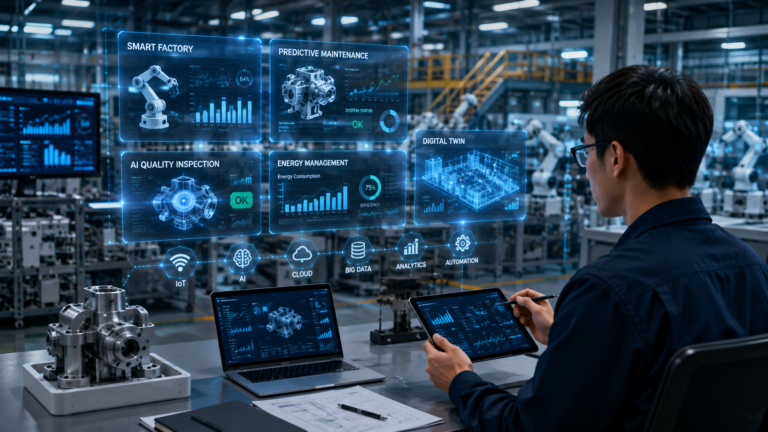
The EFR32MG29’s combination of wireless connectivity and local processing could support industrial monitoring applications where devices analyze sensor information close to the equipment.
Predictive maintenance is a good example.
Predictive Maintenance Is a Natural Edge AI Use Case
Industrial machines generate enormous amounts of physical data.
Motors vibrate.
Bearings produce sound.
Equipment changes temperature.
Electrical systems generate characteristic current patterns.
Changes in those signals can indicate developing problems.
A conventional sensor might transmit all of this information continuously.
An intelligent edge sensor can potentially analyze the pattern locally.
A small machine-learning model could identify when vibration begins to deviate from normal behavior.
The device could then send an alert.
This reduces network traffic and allows faster detection.
It also demonstrates why AI acceleration in a wireless microcontroller can be valuable.
The AI workload does not need to be enormous.
It simply needs to perform one specialized task efficiently.
Battery Life Remains Critical
IoT intelligence is useful only if the device can operate practically.
Many connected sensors run on batteries.
Replacing those batteries can become one of the largest operational costs of an IoT deployment.
Imagine a commercial building containing thousands of sensors.
Even if replacing one battery takes only a few minutes, maintaining the entire deployment becomes expensive.
Power efficiency is therefore fundamental to IoT semiconductor design.
Every computation consumes energy.
Every wireless transmission consumes energy.
Local AI creates an interesting trade-off.
Processing data locally requires computation, but it can potentially reduce wireless communication.
In some applications, that can improve overall efficiency.
The optimal balance depends on the workload.
Edge AI Can Improve Privacy
Privacy is another potential advantage of local processing.
A smart-home sensor may collect information about what happens inside a private residence.
A building sensor could observe employee behavior.
An industrial system might process commercially sensitive information.
Sending every raw signal to a remote cloud environment may not always be desirable.
Edge processing allows developers to keep more information locally.
For example, a device could analyze sensor data and transmit only a classification or alert.
The raw information never needs to leave the device.
That does not automatically make an IoT product private.
Privacy depends on the complete product design.
But local processing gives developers more architectural choices.
AI at the Edge Is Different From Generative AI
It is important not to confuse the AI capability of a microcontroller such as the EFR32MG29 with cloud-based generative AI.
The device is not designed to run enormous language models comparable to leading AI assistants.
Its AI acceleration targets smaller machine-learning workloads.
These might include anomaly detection, sensor classification, pattern recognition or similar applications.
The distinction matters because the term “AI” now covers an extremely wide range of computing.
A hyperscale GPU cluster and a tiny embedded microcontroller can both perform AI calculations, but the workloads are completely different.
Edge AI focuses on doing a small number of useful tasks with extremely limited computing and power resources.
TinyML Could Put AI Everywhere
This leads to a much larger technology trend.
There are billions of microcontroller-class devices in the world.
They exist inside appliances, cars, industrial machines, sensors, medical devices and consumer electronics.
If machine learning becomes practical on even a fraction of those devices, AI becomes far more distributed.
Instead of intelligence existing primarily inside smartphones and cloud data centers, basic AI capabilities can appear almost everywhere.
This is the promise of TinyML.
The individual models may be small.
But the number of devices can be enormous.
Platforms such as EFR32MG29 provide the semiconductor foundation for that transition.
Matter Could Accelerate Device Innovation
Matter adds another interesting dimension.
Historically, smart-home manufacturers needed to decide which ecosystem to support.
That fragmented development resources.
A company might create separate products or software integrations for different platforms.
Matter attempts to reduce that burden through standardized interoperability.
If the ecosystem continues expanding, hardware platforms supporting Matter can help manufacturers reach a broader market with fewer product variations.
This could be especially valuable for smaller IoT companies.
Large technology companies can afford to maintain many integrations.
Startups and smaller hardware manufacturers have more limited engineering resources.
Standards can lower that barrier.
Interoperability Still Depends on Implementation
However, supporting Matter does not automatically guarantee a perfect consumer experience.
Wireless reliability still matters.
Device firmware matters.
Application design matters.
Ecosystem certification matters.
Security updates matter.
Router and border-router compatibility can matter.
The smart-home industry has learned repeatedly that standards alone cannot eliminate every interoperability problem.
Matter provides a common foundation.
Manufacturers still need to build reliable products on top of it.
The EFR32MG29 therefore gives developers technical capabilities, but the final user experience will depend on how those capabilities are implemented.
Silicon Labs Is Betting on Series 3
The EFR32MG29 also represents Silicon Labs’ broader transition toward its Series 3 platform.
Series 3 is designed to address the growing performance, memory, security and connectivity requirements of next-generation IoT products.
As embedded applications become more sophisticated, semiconductor companies need to increase computing capability without abandoning the low-power characteristics that made microcontrollers attractive in the first place.
That is a difficult engineering balance.
More performance usually consumes more energy.
More memory increases silicon requirements.
More wireless capabilities increase complexity.
AI acceleration adds another computing block.
Highly integrated platforms attempt to manage those competing requirements within a single SoC.
Mouser Brings EFR32MG29 to Developers
Mouser Electronics’ role in the announcement is distribution.
As an electronics component distributor, Mouser gives engineers and manufacturers access to semiconductors, development hardware and technical resources from a wide range of suppliers.
Making the EFR32MG29 available through distribution channels can help developers begin evaluating the technology without requiring a large direct semiconductor purchasing relationship.
This matters particularly during product development.
Engineers may need only a small number of devices while building prototypes.
If the design eventually moves into mass production, purchasing volumes can increase significantly.
Distribution therefore plays an important role between semiconductor development and commercial product adoption.
Developer Tools Will Influence Adoption
Hardware specifications are only part of the decision when engineers choose an IoT platform.
Software tools can be equally important.
Developers need wireless stacks.
They need example applications.
They need debugging tools.
They need security libraries.
For AI applications, they also need ways to convert trained models into formats that can execute efficiently on the embedded hardware.
A technically impressive chip can struggle commercially if developers find it difficult to use.
Semiconductor companies therefore increasingly compete through complete development ecosystems rather than processor specifications alone.
Silicon Labs’ Series 3 strategy includes software and development tools designed around its wireless platforms.
The IoT Market Is Entering a New Phase
The first phase of IoT was about connectivity.
Manufacturers asked whether a product could connect to the internet.
The next phase focused on cloud platforms.
Connected devices sent information to centralized systems where companies could store and analyze it.
The emerging phase adds intelligence directly to the device.
This does not replace connectivity or cloud computing.
It adds another layer.
A device can sense.
It can process.
It can make limited decisions.
It can communicate.
And it can do those things while consuming very little power.
That architecture can create IoT products that are faster, more resilient and potentially more private.
EFR32MG29 Reflects the Rise of Intelligent IoT
The EFR32MG29 ultimately illustrates how rapidly the definition of an IoT chip is changing.
Wireless connectivity is no longer enough.
Manufacturers increasingly need multiple protocols.
They need stronger security.
They need more memory.
They need greater processing capability.
And increasingly, they want hardware acceleration for machine learning.
Silicon Labs has combined these requirements into a Series 3 SoC aimed at smart-home, building-automation, energy and industrial applications, while Mouser is expanding access to the platform for developers.
The result reflects a broader transition from connected devices toward intelligent connected devices.
Matter and Zigbee can help those products communicate.
Bluetooth LE can simplify interaction and configuration.
Hardware security can protect their identities.
Edge AI can help them understand the information they collect.
And low-power semiconductor design can allow them to perform those tasks without the computing resources of a smartphone or data center.
That combination could ultimately be more important than any individual specification.
The next expansion of artificial intelligence may not happen only through ever-larger models running on ever-larger GPU clusters.
It may also happen quietly inside billions of tiny devices that learn to make simple decisions for themselves.