
MediaTek Genio 420 is expanding the reach of on-device generative AI into mainstream Internet of Things products, giving manufacturers a lower-power platform for smart home devices, retail systems, industrial equipment and other connected products that need AI processing without depending entirely on the cloud.
Mouser Electronics has begun supplying MediaTek’s Genio 420 GenAI-capable IoT platform, making the processor available to engineers developing embedded and edge-AI products. The chip combines an octa-core CPU, dedicated neural processing unit, graphics processing, multimedia capabilities and modern connectivity in a 6nm design.
The significance of the Genio 420 goes beyond another IoT processor entering distribution.
Generative AI is gradually moving away from a model in which virtually every request is sent to a remote data center. More AI workloads can now run directly on local devices, particularly when models are optimized for specific tasks.
That transition could reshape products ranging from smart displays and home automation systems to industrial control panels and intelligent retail equipment.
For device manufacturers, local AI can potentially reduce latency, improve privacy and lower dependence on continuous cloud connectivity.
MediaTek Genio 420 Targets Edge GenAI
MediaTek designed the Genio 420 specifically for embedded applications requiring reliable, power-efficient edge AI and generative AI.
The platform is manufactured using a 6nm process and integrates MediaTek’s eighth-generation neural processing unit.
The NPU itself delivers 6.1 TOPS of AI acceleration, while MediaTek rates total system AI performance at 7.2 TOPS.
That processing capability is intended for workloads including object detection, image classification and speech recognition.
More importantly, MediaTek says the platform can support generative AI applications and leading large language models directly on the device.
This does not mean the Genio 420 is designed to run the largest frontier AI models found in massive data centers.
Instead, it reflects a growing market for smaller and optimized models capable of operating on embedded hardware.
That distinction is important.
The future of AI computing may not involve choosing between cloud AI and device AI. Increasingly, products are likely to use both.
Why On-Device AI Matters
Cloud computing has been essential to the rapid development of generative AI.
Large data centers provide enormous amounts of GPU capacity that consumer devices cannot match.
But cloud AI also introduces limitations.
Data needs to travel across a network.
That creates latency.
Connectivity can become unreliable.
Cloud inference also creates an ongoing operating cost because every request consumes remote computing resources.
Privacy can become another consideration when sensitive information needs to leave the device for processing.
On-device AI provides an alternative for suitable workloads.
A smart device can process information locally and contact cloud infrastructure only when necessary.
This hybrid architecture can potentially create faster and more resilient products.
For example, a voice-enabled home device could perform some speech recognition locally.
An industrial camera could identify common objects without continuously transmitting video to a remote server.
A retail terminal could perform basic AI analysis locally while using the cloud for more demanding tasks.
The MediaTek Genio 420 is designed for this growing middle ground between conventional embedded computing and high-end AI infrastructure.
AI Processing Gets Dedicated Hardware
The dedicated NPU is central to that strategy.
Traditional processors can execute AI workloads, but they are not always the most efficient hardware for doing so.
Neural processing units are designed specifically to accelerate the mathematical operations commonly used by machine-learning models.
This can provide better performance per watt than relying entirely on a CPU.
Power efficiency matters considerably in embedded systems.
A data-center server can consume large amounts of electricity and use sophisticated cooling.
A wall-mounted smart-home controller cannot.
The same is true for compact retail devices, industrial terminals and other embedded products.
Hardware designers therefore need to balance AI performance with power consumption, heat and physical size.
Dedicated AI acceleration makes that balance easier.
An Octa-Core CPU Handles General Computing
AI is only one part of an IoT device.
The Genio 420 therefore includes an eight-core CPU configuration.
Two Arm Cortex-A78 cores handle higher-performance workloads, while six Cortex-A55 cores provide more efficient processing for lighter tasks.
This type of heterogeneous CPU architecture allows a system to allocate work according to performance requirements.
A demanding application can use the higher-performance cores.
Background processes can run on more efficient cores.
That matters for devices expected to remain active for long periods while consuming relatively little electricity.
The CPU is paired with an Arm Mali-G57 MC2 GPU for graphics processing.
Together with the NPU, this creates three different categories of computing resources within the same platform: general-purpose CPU processing, graphics acceleration and dedicated AI acceleration.
Modern embedded operating systems can distribute workloads across those resources according to the application.
Genio 420 Supports Rich Displays
MediaTek is also targeting products with sophisticated visual interfaces.
The Genio 420 can support dual displays at up to 2.5K60 or a single ultrawide display at up to 5K60.
This expands the platform beyond simple sensor-based IoT devices.
Digital signage is an obvious application.
Interactive retail displays are another.
Smart-home control panels can combine visual interfaces with voice and AI.
Industrial equipment increasingly uses high-resolution touchscreens instead of conventional buttons and small displays.
Healthcare and education systems can also require sophisticated multimedia interfaces.
Generative AI adds another layer to these applications.
A display no longer needs to present only predefined menus.
It could potentially provide a conversational interface that adapts to the user.
Video Processing Expands Vision Applications
The platform also supports 4K video encoding and decoding and includes an image signal processor for camera applications.
Camera support is important because computer vision remains one of the largest practical categories of edge AI.
A smart retail system can analyze visual activity.
An industrial camera can inspect products.
A home automation device can identify people or objects.
A transportation system can analyze its surroundings.
Running some of these workloads locally can reduce the amount of video that needs to be transmitted to the cloud.
That can save bandwidth and potentially improve privacy.
Instead of uploading an entire video stream, a device could process images locally and transmit only relevant events or metadata.
Edge AI Can Reduce Latency
Latency becomes especially important when AI output affects an immediate physical interaction.
Consider a smart control panel responding to voice commands.
If every command needs to travel to a distant cloud server before the interface reacts, delays can make the system feel less responsive.
Local inference can shorten that loop.
Industrial systems can be even more sensitive.
A camera identifying a production defect may need to trigger an action immediately.
An intelligent kiosk needs to respond quickly enough that customers do not feel they are waiting for the interface.
On-device processing does not eliminate all latency, but it removes part of the network dependency.
MediaTek explicitly positions the Genio 420 around real-time, low-latency AI inference at the edge.
Privacy Creates Another Edge AI Opportunity
Privacy may become an equally important driver.
AI products become more useful when they can process personal context.
But consumers and businesses may not want every interaction sent to remote infrastructure.
Local processing provides another architectural option.
Voice data could potentially be analyzed locally.
Camera information might remain on the device.
Sensitive industrial information could be processed without continuously transmitting raw data externally.
Whether a specific Genio 420 product actually provides those privacy benefits will depend on how the manufacturer designs its software.
A processor alone cannot guarantee privacy.
But hardware capable of local AI gives developers the option to keep more processing on the device.
Genio 420 Supports Major Operating Systems
Software support is another important part of MediaTek’s strategy.
The Genio 420 supports Android, Yocto Linux and Ubuntu.
That gives manufacturers flexibility depending on the type of product they are developing.
Android can be useful for interactive consumer and commercial devices.
Yocto Linux is widely used to build customized embedded Linux distributions.
Ubuntu provides a familiar Linux environment for developers and enterprise applications.
Hardware capability alone does not determine whether an embedded platform succeeds.
Developers also need operating systems, drivers, development tools and long-term software support.
This becomes even more important for AI because models need to interact efficiently with the NPU and other accelerators.
MediaTek NeuroPilot Supports AI Development
MediaTek’s broader Genio ecosystem includes its NeuroPilot software development environment.
The objective is to help developers optimize and deploy AI models across MediaTek hardware.
This software layer is critical because developers generally do not want to manually optimize every neural-network operation for a particular processor.
AI development frameworks need to translate models into workloads the hardware can execute efficiently.
The easier that process becomes, the larger the potential developer ecosystem.
For MediaTek, therefore, Genio is not simply a collection of processors.
It is an attempt to create an embedded AI platform combining silicon, operating-system support and development tools.
Genio 420 Fits Below More Powerful Platforms
The Genio 420 also fills a specific position within MediaTek’s product portfolio.
MediaTek announced the platform at Embedded World 2026 alongside other additions to the Genio family.
The company positions Genio 420 and Genio 360 as efficient platforms for smart-home, retail, industrial and commercial IoT devices, while the Genio Pro family targets substantially more demanding applications such as autonomous mobile robots, drones and machine vision.
This segmentation is important for the economics of edge AI.
Not every device needs maximum AI performance.
Installing an expensive processor into a simple control panel would increase product cost unnecessarily.
The mainstream market needs processors capable of useful AI acceleration at a price and power level appropriate for mass deployment.
Genio 420 is designed for that segment.
Compatibility Could Simplify Product Development
Another important feature is compatibility within the Genio family.
MediaTek says Genio 420 is pin-to-pin and software compatible with Genio 720 and Genio 520.
That can provide meaningful benefits to device manufacturers.
A company may want to build several products with different performance and price levels.
If processors require completely different hardware designs, each product can require significant engineering work.
Platform compatibility can make it easier to reuse board designs and software.
A manufacturer could potentially develop a product family using different Genio processors according to performance requirements.
That can reduce development time and improve supply-chain flexibility.
Memory Flexibility Addresses Supply Constraints
MediaTek has also emphasized memory flexibility.
The Genio 420 supports both LPDDR4X and LPDDR5-family memory technologies. MediaTek says the platform can support LPDDR4X at up to 4,266Mbps with capacities up to 8GB, or LPDDR5(X) at up to 6,400Mbps with capacities up to 16GB.
This matters for more than performance.
MediaTek specifically connected the decision to memory supply-chain constraints.
Embedded devices can remain in production for many years.
Manufacturers therefore care about component availability as well as benchmark performance.
Supporting multiple memory generations gives designers more sourcing flexibility.
It can also help manufacturers balance product cost against performance.
Connectivity Is Built for Modern IoT
Connected devices obviously need connectivity.
Genio 420 includes integrated options for Wi-Fi 6 or Wi-Fi 6E and Bluetooth 5.3, while the broader platform can support expansion for technologies including Wi-Fi 7 and 5G RedCap.
The variety reflects the increasingly diverse IoT market.
A smart-home controller may primarily use Wi-Fi.
Industrial equipment might use Ethernet.
A mobile IoT product may benefit from cellular connectivity.
Bluetooth can connect accessories and nearby sensors.
5G RedCap is particularly interesting for IoT because it is designed to provide a middle tier of cellular capability between high-performance 5G devices and lower-bandwidth IoT technologies.
This allows manufacturers to select connectivity according to the application rather than designing around a single network technology.
Security Starts at the Hardware Level
Security becomes increasingly important as AI moves into connected devices.
A compromised smart device can expose personal information.
An industrial IoT device can potentially provide access to operational networks.
AI introduces additional concerns because models and locally stored information can themselves become valuable targets.
Genio 420 includes hardware-oriented security features such as Arm TrustZone, secure boot, a cryptographic engine and random-number generation capabilities.
Secure boot helps ensure that a device starts using authorized software rather than modified malicious firmware.
TrustZone can provide isolated execution environments for sensitive operations.
Cryptographic hardware can accelerate security functions.
Again, these components do not automatically make a finished device secure.
Security depends on the complete hardware and software implementation.
But they provide manufacturers with important building blocks.
Smart Homes Could Become More Intelligent Locally
Home automation is one of the clearest target markets for MediaTek Genio 420.
Today’s smart-home products often rely heavily on cloud services.
Voice commands may be processed remotely.
Camera footage can be uploaded.
Automation decisions can depend on external servers.
More capable edge AI can shift part of that intelligence back into the home.
A control panel could understand more commands locally.
A security system could identify common events without uploading every image.
An appliance could adapt to user behavior.
A home hub could potentially coordinate smaller AI models across connected devices.
This does not necessarily eliminate cloud services.
Instead, the cloud can become one layer of a hybrid system.
Retail Is Another Strong Use Case
Retail environments are also becoming increasingly digital.
Stores use electronic signage, interactive kiosks, self-service terminals and increasingly intelligent inventory systems.
AI can add new capabilities.
A kiosk could provide natural-language assistance.
Digital signage could adapt information to context.
Computer vision can help monitor shelves or customer flows.
Local AI processing can reduce the need for every interaction to depend on remote servers.
It can also improve responsiveness.
MediaTek specifically lists smart retail and interactive displays among the target applications for Genio 420.
For retailers deploying thousands of devices, power efficiency and hardware cost become particularly important.
That helps explain why a mainstream AI platform could be commercially significant.
Industrial IoT Needs Long-Lifecycle Hardware
Industrial products have different requirements from consumer electronics.
A smartphone may be replaced after several years.
Industrial machinery can remain in operation for a decade or longer.
Manufacturers therefore care about stability, operating-system support and component availability.
Genio 420’s support for multiple Linux environments and flexible memory options makes the platform relevant to this market.
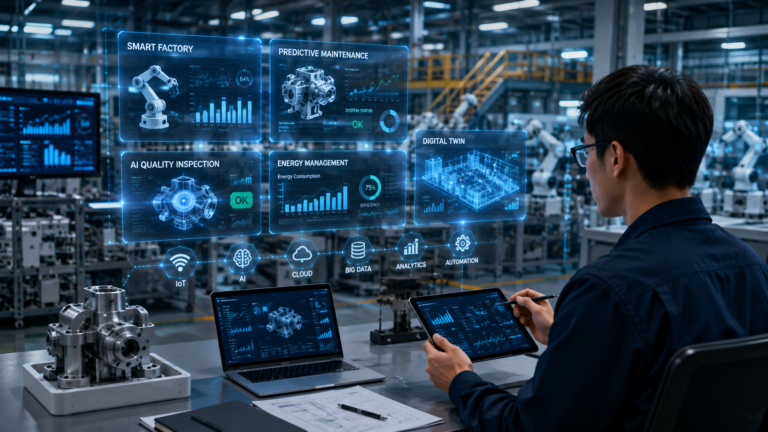
Edge AI can also provide practical industrial value.
Machine-vision systems can inspect products.
Predictive-maintenance applications can analyze equipment signals.
Control panels can use natural-language interfaces.
Sensors can process data before transmitting it.
These applications do not always require enormous AI models.
Efficient specialized models can often provide more practical value.
Edge GenAI Could Change Human-Machine Interfaces
One of the most interesting opportunities involves human-machine interfaces.
Traditional embedded interfaces are rigid.
A user selects from menus and buttons predefined by the manufacturer.
Generative AI can make interfaces more flexible.
Instead of navigating through multiple screens, a user might simply describe what they want.
An industrial technician could ask a machine about recent error conditions.
A retail customer could ask a kiosk to compare products.
A home user could describe an automation rule in natural language.
A healthcare terminal could provide contextual assistance.
Running at least part of these interactions locally could make AI interfaces faster and more private.
The Genio 420’s combination of display, multimedia and NPU capabilities is particularly relevant to this category.
The Cloud Will Not Disappear
The rise of edge AI should not be interpreted as the end of cloud AI.
Large models still require substantial computing resources.
Cloud infrastructure also provides centralized updates, large-scale storage and access to much more powerful models.
The more likely architecture is hybrid.
A device handles common or privacy-sensitive tasks locally.
The cloud handles workloads that require greater reasoning capability or information unavailable on the device.
Software determines which environment should process each request.
This approach can balance performance, privacy and cost.
The MediaTek Genio 420 provides hardware for the device side of that architecture.
Edge AI Could Reduce Inference Costs
Economics may become another major reason companies adopt local AI.
Cloud inference has a recurring cost.
Every request consumes computing capacity.
For a device used occasionally, that cost may be insignificant.
For millions of devices operating continuously, it can become substantial.
If common workloads can run locally, manufacturers may be able to reduce the amount of remote inference required.
The economics are not automatically better.
More powerful edge hardware costs more upfront.
Developers need to optimize models.
Devices consume electricity.
But local processing converts some recurring cloud expenditure into device-side computation.
For high-volume products, that trade-off could become increasingly attractive.
Mouser Expands Availability to Engineers
Mouser’s role in the announcement is distribution.
The electronics distributor now offers the Genio 420 to engineers and manufacturers through its global component distribution network.
This matters because semiconductor commercialization depends on more than announcing a processor.
Developers need access to components, documentation and engineering resources.
Distribution can help smaller manufacturers evaluate technology without negotiating directly with the chipmaker.
Mouser specializes in new-product introductions and carries components from a large range of semiconductor and electronics manufacturers.
For MediaTek, distribution through Mouser can therefore broaden the audience for Genio beyond the company’s largest direct customers.
MediaTek Expands Beyond Smartphones
The Genio family also illustrates MediaTek’s broader diversification.
The company is widely known for smartphone chipsets, but its semiconductor portfolio extends across connectivity, smart-home technology, automotive applications and IoT.
Embedded AI creates another growth opportunity.
The same fundamental technologies used in mobile computing — efficient CPUs, GPUs, wireless connectivity, multimedia processing and AI acceleration — are increasingly valuable across many other device categories.
IoT allows those capabilities to spread into products that historically used much simpler processors.
Generative AI could accelerate that transition because even ordinary devices may require substantially more local computing power.
Mainstream Edge AI Is the Bigger Story
High-end AI accelerators attract much of the industry’s attention because they power enormous generative AI models.
But the number of edge devices is potentially far larger than the number of data-center servers.
Smart appliances, cameras, displays, vehicles, industrial controllers and commercial terminals exist in enormous quantities.
If even a portion of those products adopt dedicated AI acceleration, edge AI becomes a significant semiconductor market.
The important question is therefore not only how powerful the world’s largest AI models become.
It is how cheaply and efficiently useful AI can be deployed into ordinary products.
Genio 420 is MediaTek’s answer for part of that market.
MediaTek Genio 420 Pushes GenAI to the Edge
The MediaTek Genio 420 represents a broader shift in artificial intelligence from centralized computing toward distributed intelligence.
The 6nm platform combines an octa-core Arm CPU, Mali GPU and eighth-generation MediaTek NPU capable of 6.1 TOPS of dedicated acceleration and 7.2 TOPS at the system level.
It supports major embedded operating systems, high-resolution displays, camera applications and multiple connectivity technologies.
Most importantly, it gives manufacturers enough local AI capability to consider generative AI and other machine-learning functions without automatically sending every task to the cloud.
The practical impact will depend on the products manufacturers build around it.
A semiconductor platform does not create a successful AI application by itself.
Developers still need optimized models, secure software and useful product experiences.
But the hardware foundation is becoming increasingly accessible.
As chips such as Genio 420 move into mainstream IoT devices, generative AI may gradually become less visible as a standalone service and more deeply embedded inside everyday products.
The next major expansion of AI may therefore happen somewhere very different from the data center.
It could happen inside the control panel, display, appliance or machine sitting directly in front of the user.