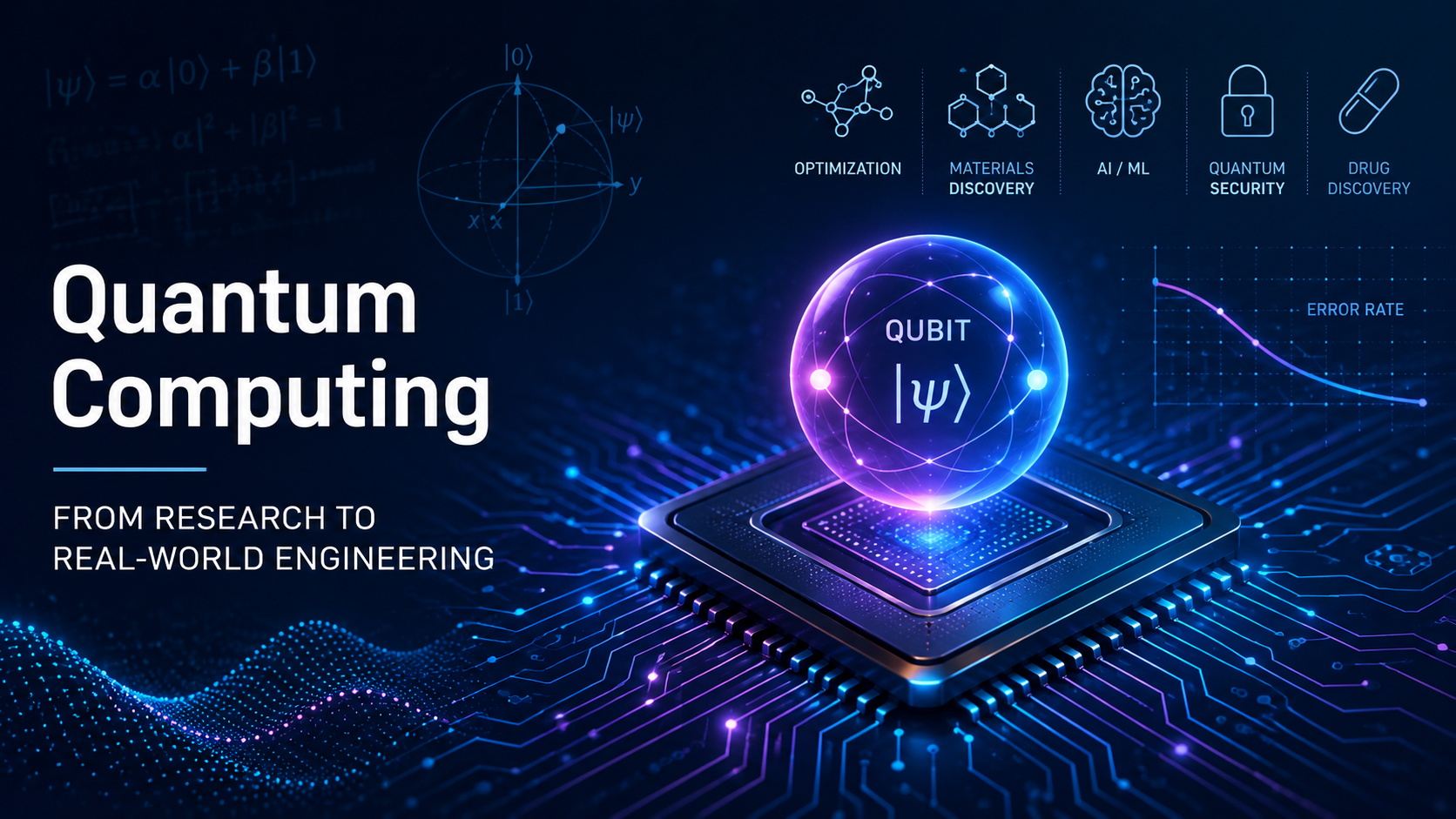

Mouser Electronics has released a new installment of its Empowering Innovation Together (EIT) technology series focused on quantum computing, as engineers and researchers continue working to move quantum systems from experimental research toward practical applications.
The new installment, titled “A Quantum Leap in Computer Processing,” examines the principles behind quantum computing as well as the engineering challenges that continue to limit the technology’s real-world deployment.
From Qubits to Practical Applications
Unlike conventional computers, quantum systems use phenomena including superposition, entanglement and interference to perform computation in fundamentally different ways.
Current quantum systems, however, still face significant challenges, particularly in error rates and scalability. Advances in qubit technologies and quantum error correction are therefore central to efforts to build systems capable of delivering practical computational advantages.
Mouser’s latest EIT installment examines several areas in which quantum computing could eventually play a role, including optimization, materials discovery, artificial intelligence and machine learning, cryptography and drug discovery.
Quantum Error Correction Takes Center Stage
A central part of the new series is an episode of Mouser’s “The Tech Between Us” podcast featuring Daniel Gottesman, a theoretical computer scientist and physicist at the University of Maryland known for his work in quantum error correction.
Gottesman joins Mouser Technical Content Director Raymond Yin to discuss the fundamentals of quantum computing, current hardware architectures, technical barriers facing the field and the potential trajectory of quantum systems.
Quantum error correction is particularly important because quantum states are highly susceptible to noise and errors. Developing techniques capable of detecting and correcting those errors without undermining quantum computation remains one of the major engineering challenges facing the industry.
Beyond the Quantum Computing Hype
The EIT materials also examine noisy intermediate-scale quantum (NISQ) systems, optimization, AI and machine learning, quantum-resistant cryptography and security.
One case study highlighted by Mouser explores the potential use of quantum annealing to search large chemical spaces more efficiently, an approach researchers are investigating as a possible tool for accelerating parts of the drug discovery process.
Despite the growing interest surrounding quantum technologies, practical quantum computing remains an evolving field. Current systems continue to face hardware, noise, error-correction and scaling challenges that must be addressed before many proposed applications can become commercially practical.
Mouser’s latest educational initiative reflects the broader effort across the technology industry to prepare engineers for a computing model that remains experimental today but could eventually complement conventional computing in specialized applications.
Source: Mouser Electronics announcement distributed via Newswire/Business Wire.